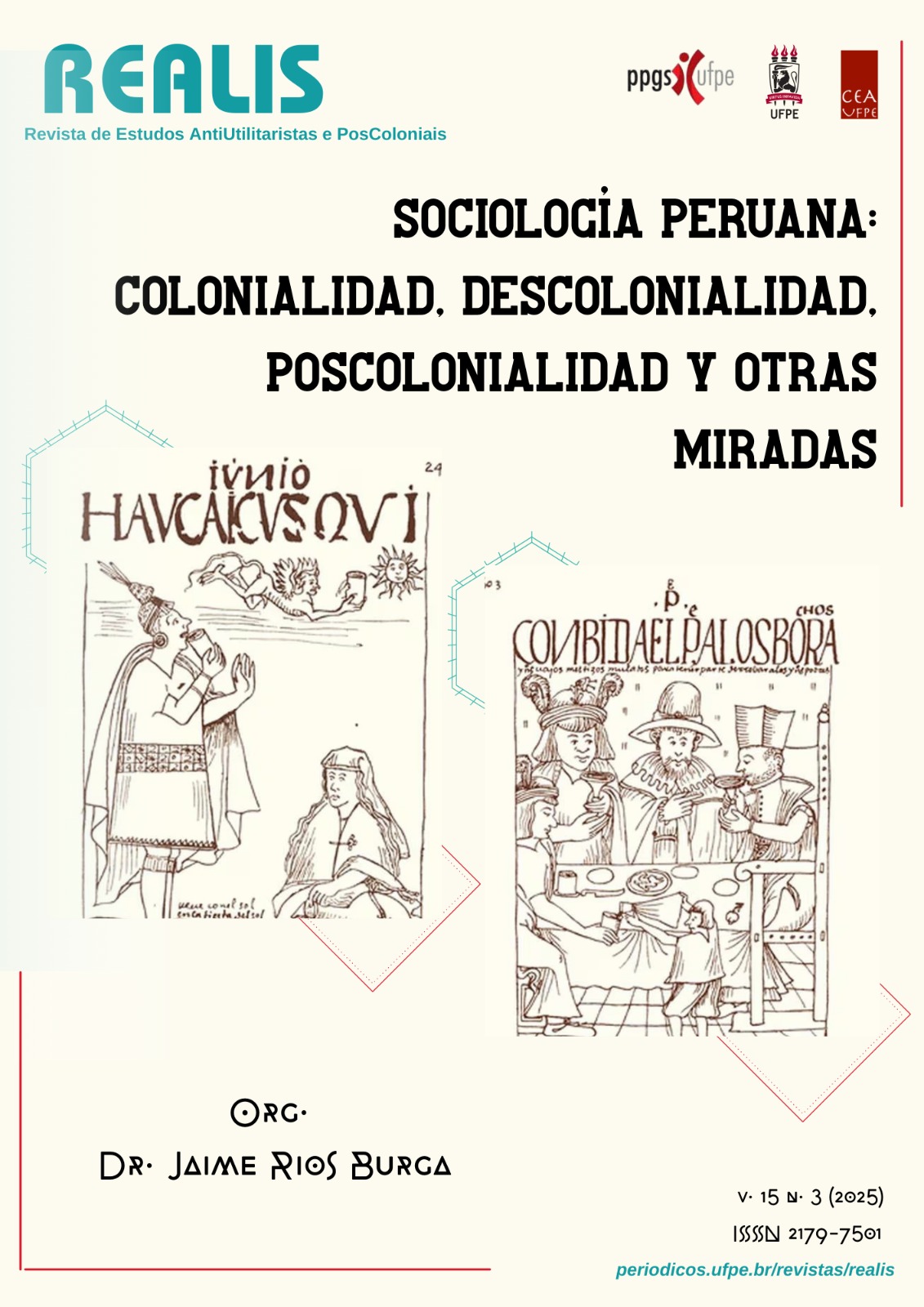
Sociologia na encruzilhada. O campo da sociologia no Peru
DOI:
https://doi.org/10.51359/2179-7501.2025.268756Parole chiave:
campo da sociologia, colonialidade do poder, papel do sociólogo, ciência social descolonialAbstract
O ensaio busca examinar o debate em torno de algumas problemáticas significativas: na primeira parte, aborda-se, em primeiro lugar, o exame de enfoques que apresentam perspectivas opostas sobre o papel que cabe aos sociólogos e às sociólogas em uma era de transição do incerto sistema-mundo moderno/colonial em que vivemos. Em segundo lugar, explora-se um problema epistemológico central na sociologia: o debate sobre a relação entre a predominância, na prática sociológica, da grande teoria ou da pesquisa empírica. Na terceira problemática, examina-se o debate sobre a democracia: os pressupostos que sustentam os diferentes posicionamentos, assim como os caminhos propostos para o seu desenvolvimento.Na segunda parte do ensaio, busca-se identificar elementos que nos aproximem da pergunta sobre para onde vai a sociologia; são propostas algumas reflexões sobre o futuro da disciplina, levando em conta o debate que contrapõe a engenharia social e a crítica social. Embora seja certo que o futuro é, por natureza, incerto, assim como o que ocorrerá com o desenvolvimento posterior da sociologia, também é possível que possamos contribuir para moldá-la. Com esse propósito, na terceira parte, apresentam-se algumas ideias que podem auxiliar na construção de uma ciência social descolonial. Considerando a complexidade do campo sociológico aqui discutido, encontramo-nos em uma encruzilhada onde se torna imperativo impulsionar o desenvolvimento de uma sociologia crítica e utópica para compreender e transformar o mundo em que vivemos.
Riferimenti bibliografici
Adorno, Theodor W. y Horkheimer, Max, 1968. La sociedad. Lecciones de sociología. Buenos Aires: Proteo.
Bourdieu, Pierre y Wacquant, Loïc, 2005. Una invitación a la sociología reflexiva. Buenos Aires: Siglo XXI editores.
Cerroni, Umberto, 1975. La teoría de las crisis sociales en Marx. Madrid: Alberto Corazón Editor.
Finley, Moses I., 1986. El nacimiento de la política. Barcelona: Crítica.
Germana, César, 1995. El socialismo indo-americano de José Carlos Mariátegui. Proyecto de reconstitución del sentido histórico de la sociedad peruana. Lima: Amauta.
Mariátegui, José Carlos, 1994. Mariátegui Total. Lima: Amauta. t. I.
Marx, Karl, 1971. Elementos fundamentales para la crítica de la economía política (borrador). Buenos Aires: Siglo XXI editores. Vol. I.
Mills, C. Wright, 1964. La imaginación sociológica. México: Fondo de Cultura Económica.
Prigogine, Ilya, 1997. El fin de las certidumbres. Madrid: Taurus.
Quijano, Aníbal, 1965. “Imagen y tareas del sociólogo en la sociedad peruana”, en: Letras, Lima, Año XXXVII, Números 74-75.
Quijano, Aníbal, 1991. “Introducción” a: José Carlos Mariátegui. Textos Básicos. Colección Tierra Firme, Lima: FCE.
Quijano, Aníbal, 1994. “Algunas cuestiones acerca de un plan de estudios para la Escuela de Sociología”, en: Universidad y Sociedad, Año 2, N° 3.
Quijano, Aníbal, 1995. El fujimorismo y el Perú. Lima: SEDES.
Quijano, Aníbal, 2020. Cuestiones y horizontes. De la dependencia histórico-estructural a la colonialidad/descolonialidad del poder. Lima: UNMSM / CLACSO.
Quijano, Aníbal, 2022. Vivir adentro y en contra. Colonialidad y descolonialidad del poder. Lima: Universidad Ricardo Palma.
Wallerstein, Immanuel, 2001. Conocer el mundo, saber el mundo. El fin de lo aprendido. Una ciencia social para el siglo XXI. México: Siglo XXI editores.
Wallerstein, Immanuel, 2002. Un mundo incierto. Buenos Aires: Libros del Zorzal.
Weber, Max, 1987. El político y el científico. Madrid: Alianza editorial.
Downloads
Pubblicato
Fascicolo
Sezione
Licenza
Copyright (c) 2025 César Germaná

Questo lavoro è fornito con la licenza Creative Commons Attribuzione - Non commerciale 4.0 Internazionale.
A revista se reserva o direito de efetuar, nos originais, alterações de ordem normativa, ortográfica e gramatical, com o intuito de manter o padrão culto da língua, respeitando, porém, o estilo dos autores;
As opiniões emitidas pelos autores são de sua exclusiva responsabilidade
Os direitos autores para artigos publicadoss nesta são dos autores, com direitos de primeira publicação para a REALIS. Todos o contéudo da revista, com exceção de caos especificamente declarados, é licenciado sob licença Creative Commons CC Atribuição Não Comercial 4.0 Internacional. Devido à política de acesso aberto da Revista, todos os artigos são gratuitos e livres para uso, com atribuição apropriada, para fins educacionais e não-comerciais.
