Idioma
Professional masters and doctorates in nursing: a documentary analysis of the brazilian panorama
|
J. Nurs UFPE on line. 2023;17:e257379 DOI: 10.5205/1981- 8963.2023.257379 https://periodicos.ufpe.br/ revistas/revistaenfermagem
|
|
|
|
|
Professional masters and doctorates in nursing: a documentary analysis of the brazilian panorama
Mestrados e doutorados profissionais em enfermagem: uma análise documental do panorama brasileiro
Maestrías y doctorados profesionales en enfermería: un análisis documental del panorama brasileño
Marina Marisa Palhano dos Santos1, Marília Souto de Araújo2, Soraya Maria de Medeiros3, Jonas Sâmi Albuquerque de Oliveira4, Alexsandra Rodrigues Feijão5
ABSTRACT
Objective: to describe and characterize the panorama of stricto sensu training in nursing in the context of professional master's degrees and doctorates. Method: this is a documentary study of descriptive nature. All the products from the post-graduation programs that offer master's and/or professional doctorate courses in Brazil were analyzed. The search procedure was carried out in June 2022 by two independent reviewers. The Voyant Tools tool was used for textual analysis. Results: three hundred and sixty-seven products comprised the sample, all of which were dissertations from professional masters' programs. It is important to point out that the only existing professional doctorate course in Brazil has not yet been completed as of the time this study was carried out. The prevalent thematic areas were assistance, education, and management. Methodological studies (34.3%) and cross-sectional studies (14.1%) were predominant. The geographical distribution of the programs revealed a predominance of São Paulo and Rio Grande do Sul. The years of highest production in total number in Brazil were 2017 and 2019, both with 28%. Conclusion: it was observed that the productions are focused on the construction of product and process technologies, and that they point to the strengthening of a continuous educational movement directed to work.
Descriptors: Education, Nursing, Graduate; Scientific Research and Technological Development; Nursing Research; Nursing Education; Nursing.
RESUMO
Objetivo: descrever e caracterizar o panorama da formação stricto sensu em enfermagem no contexto dos mestrados e doutorados profissionais. Método: trata-se de um estudo documental de natureza descritiva. Foram analisados todas os produtos provenientes dos Programas de pós-graduações que oferecem curso de mestrado e/ou doutorado profissional no Brasil. O procedimento de busca foi realizado no mês de junho de 2022 por dois avaliadores de forma independente. A ferramenta Voyant Tools foi utilizada para análise textual. Resultados: trezentos e sessenta e sete produtos compuseram a amostra, sendo constituídos, em sua totalidade, por dissertações, oriundas de mestrados profissionais. Importa salientar que o único curso de doutorado profissional existente, no Brasil, ainda não obteve concluintes até o momento em que esse estudo foi realizado. As áreas temáticas prevalentes foram assistência, educação e gestão. Estudos metodológicos (34,3%) e estudos transversais (14,1%) foram predominantes. A distribuição geográfica dos programas revelou predomínio de São Paulo e Rio Grande do Sul. Os anos de maior produção em número total no Brasil foram 2017 e 2019, ambos com 28%. Conclusão: observou-se que as produções estão voltadas para a construção de tecnologias de produto e processos, e que apontam o fortalecimento de um movimento educacional contínuo dirigido ao trabalho.
Descritores: Educação de Pós-Graduação em Enfermagem; Pesquisa Científica e Desenvolvimento Tecnológico; Pesquisa em Enfermagem; Educação em Enfermagem; Enfermagem.
RESUMEN
Objetivo: describir y caracterizar el panorama de la formación stricto sensu en enfermería en el contexto de los másteres y doctorados profesionales. Método: se trata de un estudio documental de carácter descriptivo. Se analizaron todos los productos de programas de posgrado que ofrecen cursos de maestría y/o doctorado profesional en Brasil. El procedimiento de búsqueda fue realizado en junio de 2022 por dos revisores de forma independiente. Para el análisis textual se utilizó la herramienta Voyant Tools. Resultados: trescientos sesenta y siete productos compusieron la muestra, siendo constituida, en su totalidad, por disertaciones, originadas de maestrías profesionales. Es importante destacar que el único curso de doctorado profesional existente en Brasil aún no había concluido en el momento en que se realizó este estudio. Las áreas temáticas predominantes fueron asistencia, educación y gestión. Predominaron los estudios metodológicos (34,3%) y los transversales (14,1%). La distribución geográfica de los programas reveló un predominio de São Paulo y Rio Grande do Sul. Los años de mayor producción en número total en Brasil fueron 2017 y 2019, ambos con 28%. Conclusión: se observó que las producciones se centran en la construcción de tecnologías de productos y procesos, y que apuntan al fortalecimiento de un movimiento educativo continuo dirigido al trabajo.
Descriptores: Educación de Postgrado en Enfermería; Investigación Científica y Desarrollo Tecnológico; Investigación en Enfermería; Educación en Enfermería; Enfermería.
1 Federal University of Rio Grande do Norte/UFRN. Natal (RN), Brazil.1 http://orcid.org/0000-0003-3536-3728
2 Federal University of Rio Grande do Norte/UFRN. Natal (RN), Brazil.2 http://orcid.org/ 0000-0002-6975-8683
3 Federal University of Rio Grande do Norte/UFRN. Natal (RN), Brazil.3 https://orcid.org/0000-0003-2833-9762
4 Federal University of Rio Grande do Norte/UFRN. Natal (RN), Brazil.4 http://orcid.org/0000-0003-0303-409X
5 Federal University of Rio Grande do Norte/UFRN. Natal (RN), Brazil.5 http://orcid.org/0000-0002-8686-9502
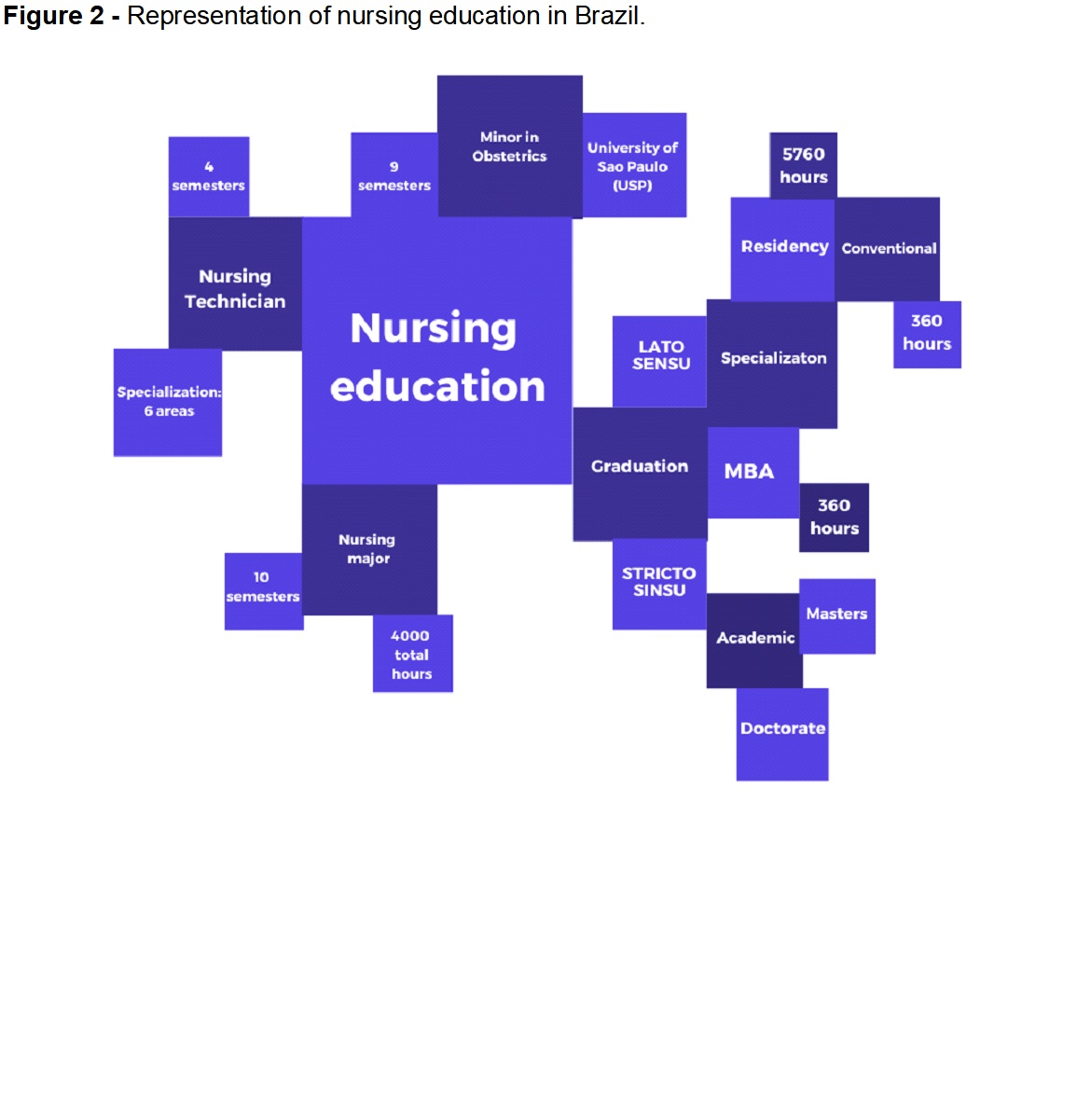
In Brazil, nursing education is guided by the technical level, higher education, and postgraduate education, although the legislation for professional practice still presents the auxiliary category.1 At the technical level, there is the professional nursing technician; at the undergraduate level, there are nurses and midwives; and at the postgraduate level, there are two modalities: stricto sensu and lato sensu.
Nursing Graduate from Education offers specializations and master’s in business administration (MBA) that make up the lato sensu mode, and masters and doctorates make up the stricto sensu mode of graduate studies; masters and doctorates can be academic or professional.
Professional masters and doctorates have been consolidating as a possibility in the formation of professionals with the prerogative of broadening work processes and expanding scientific research and technological development, besides enhancing career innovation.2
Although the professional masters and doctorates have been regulated since 1998, since 1995, the Coordination for the Improvement of Higher Education Personnel (CAPES) presented the Postgraduate Flexibility Program, presenting the need for a rapid transfer of knowledge generated in academia to society.3-4.
The existing criticism about the distance between academic production and society's needs had already been pointed out by CAPES more than 20 years ago. The institution also pointed out the confirmation that there was an indispensable need to qualify professionals in services to generate increased quality and competitiveness of human resources.3 Based on this prerogative, the professionalizing master's and doctoral degrees have a commitment to services in a more incisive way in the regulatory norms.
Considering the social commitment inherent to stricto sensu education, the development of studies focused on this object is justified, as the potential for improving the quality-of-care work and nursing praxis is evident.
In the regulations, and, consequently, in the literature, there is a gap in the characterization of the specificities of each training model (academic and professional). It is in this context that the following research question emerges: what is the scenario of nursing education in the context of professional master's and doctoral degrees?
To describe and characterize the panorama of stricto sensu training in nursing in the context of professional masters and doctorates in Brazil.
This is a documentary study, descriptive in nature. The recommendations of the Equator Network were adopted. Thus, the instrument entitled Standards for reporting qualitative research: a synthesis of recommendations (SRQR) was used in the preparation and final writing of this study. This instrument is divided into seven domains and 22 items, providing recommendations on the title and abstract, introduction, method, results, discussion, limitations, and financing of the study.
As a sample of the study, we have the following universities and their respective quantities of dissertations and/or theses: State University of Amazonas (two dissertations); Federal University of Amazonas (10 dissertations); State University of Feira de Santana (18 dissertations); State University of Santa Cruz (ten dissertations); Federal University of Health Sciences Foundation of Porto Alegre (50 dissertations); University of Vale do Rio dos Sinos (35 dissertations); Federal University of Espírito Santo (40 dissertations); Federal Fluminense Federal University (64 dissertations); Beneficent Brazilian Israelite Society Albert Einstein (55 dissertations); University of São Paulo (27 dissertations); São Paulo State University Julio de Mesquita Filho (51 dissertations). Thus, 367 dissertations comprised the sample of this study. The virtual portal of Plataforma Sucupira is the study scenario.
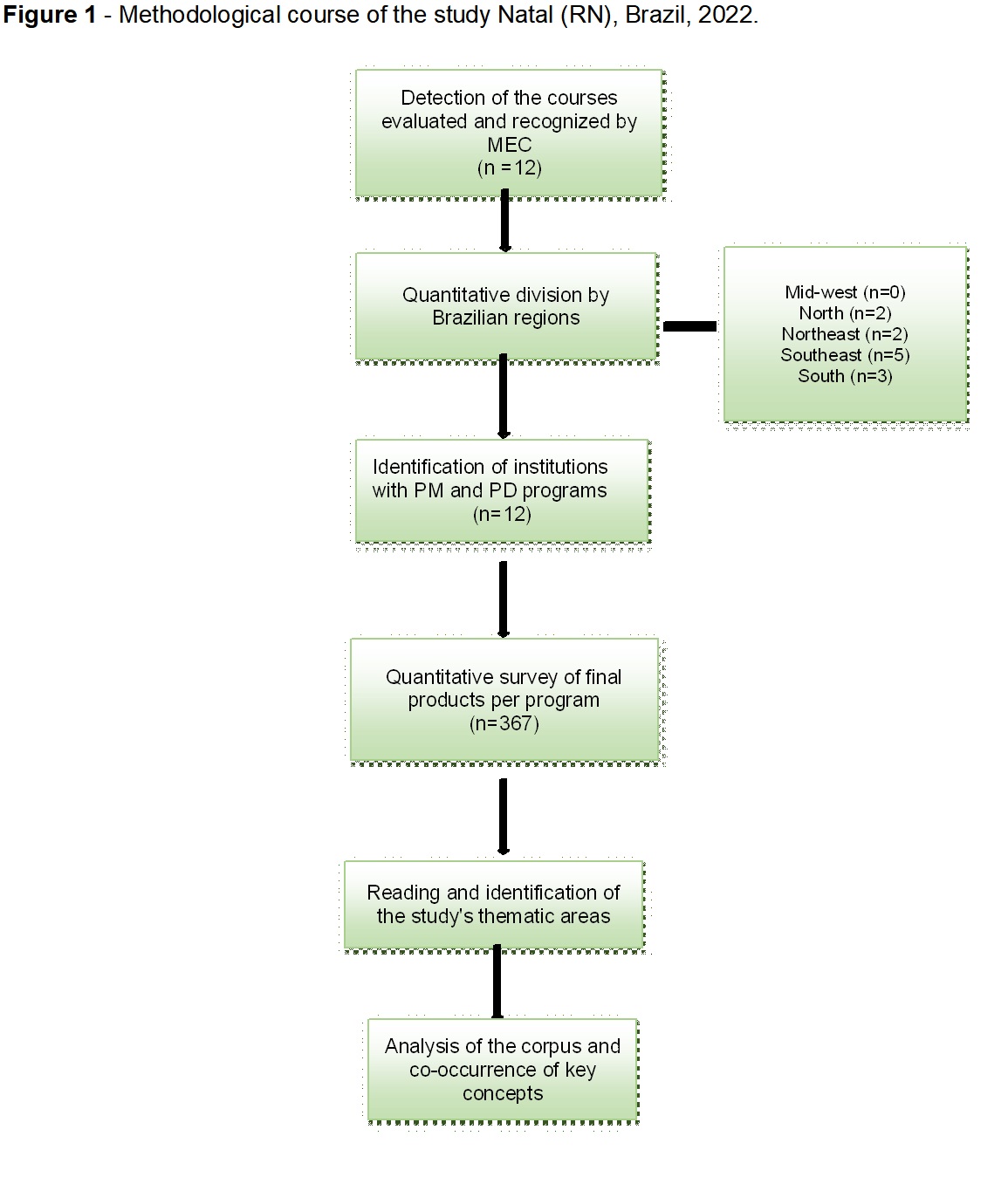
To verify the totality of the master's and professional doctorate course conclusion works from the institutions that offer the course focused on nursing, access was made to the Sucupira Platform, in the tab "evaluated and recognized courses" to verify, by region, the institutions that offer this type of training.
The inclusion criteria for graduate programs were those that were specific to the area of nursing. After defining the number of programs, the specific repository of each program was analyzed to verify the number of dissertations and theses in the time frame from 2017 to 2021. Thus, the search procedure was carried out in June 2022 by two independent evaluators.
The documents were analyzed using the document analysis technique, consisting of two steps: systematization of documents and synthesis of information.5 The studies were analyzed according to subject area, type of study, year, and methodological approach adopted. The Voyant Tools tool was used for textual analysis through a corpus formed by the titles of the selected studies. The tool, developed by Canadian researchers, uses hermeneutics as a reference for analysis.
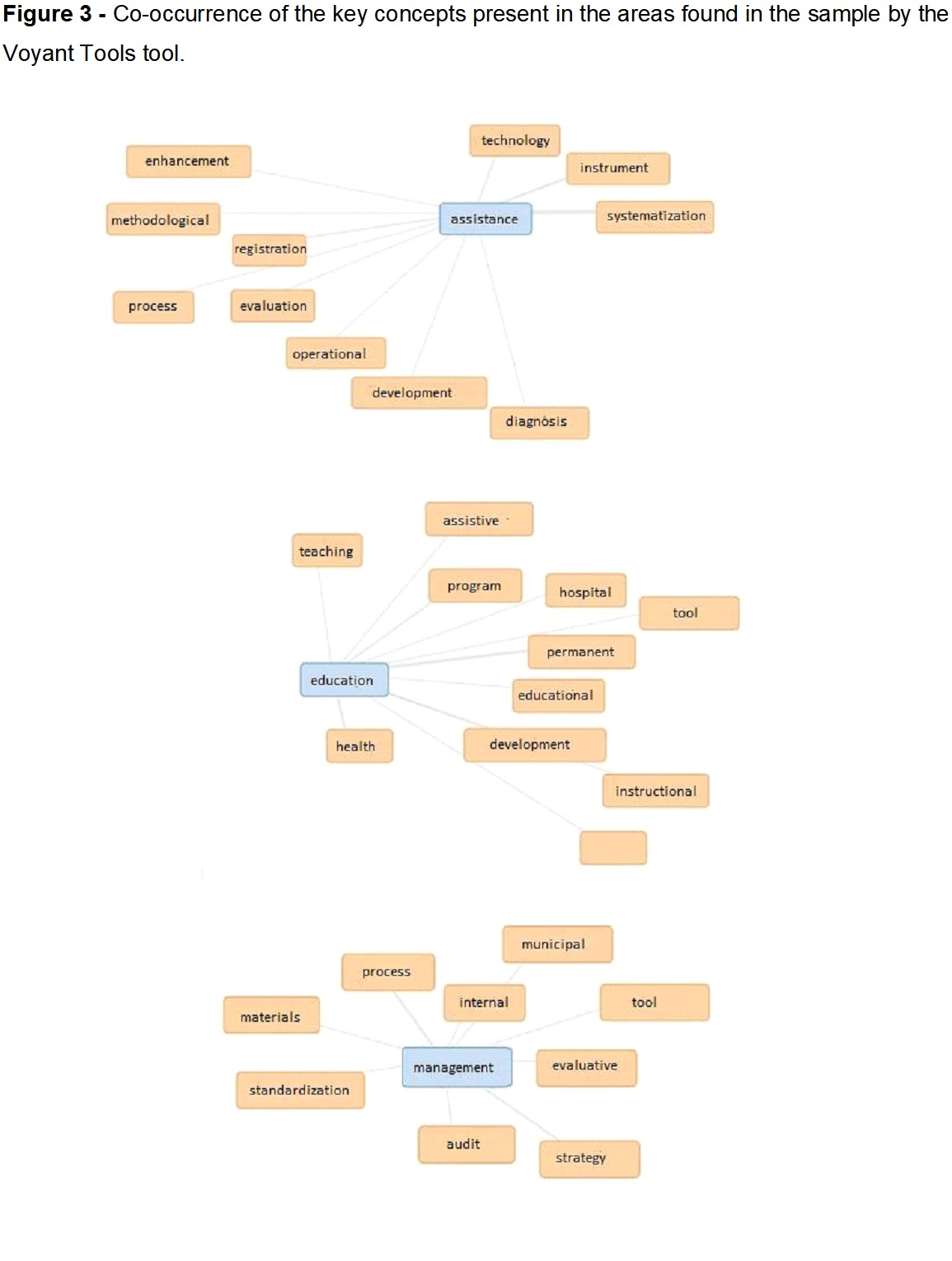
The "Links" feature was used to display the terms that appeared most frequently in proximity to key concepts throughout the corpus. The concepts selected corresponded to the respective thematic areas of nursing: care, education, and management.
The research did not require authorization from the research ethics committee because it is a documentary study. However, it should be noted that the precepts of Law 9610/98 were fully complied with to preserve and respect the ideas, concepts, and definitions of the authors of the primary studies selected.
Nursing education in Brazil is permeated by several educational paths that go through the care, administrative, academic, and technical aspects, as shown in figure 2.
Stricto sensu nursing education is the context in which the study deals more specifically with the analysis of dissertations and theses resulting from professional master's and doctoral training.
All the products of professional masters and doctorates offered in Brazil around nursing were evaluated. We evaluated 367 dissertations, which became the final sample of this study.
It is noteworthy that no products were found regarding the professional doctorate, considering that the first selection process of the only Professional Doctorate course found, belonging to the Postgraduate Program in Nursing of the Nursing Department of the Botucatu School of Medicine (UNESP), had the admission of students in March 2020; thus, the students have not completed the course to date.
Such sample is characterized by presenting studies mostly from the areas of Nursing Care 72% (272 studies), Nursing Education with 17.1% (63 studies) and Nursing Management with 8.7% (32 studies), still with their respective annual values.
Figure 3 demonstrates the key concepts most present in the studies from each area analyzed. In the field of nursing care, the studies were associated with process technologies, through the elaboration of instruments aimed at professional development and improvement, in a perspective of improving the quality of nursing care.
Around education, the studies were more focused on continuing education, with a focus on the development of educational materials and training. It is noteworthy the predominance of interventions carried out in an intersectoral manner, focusing on health education in schools. Finally, in management, the studies were related to evaluative research, focusing on auditing and analysis of materials.
Regarding the methods adopted, methodological studies (34.3%) and cross-sectional studies (14.1%) were predominant. As for the approach used, the sample was divided with a minimal percentage difference between qualitative with 184 studies (50.1%) and quantitative with 182 (49.9%).
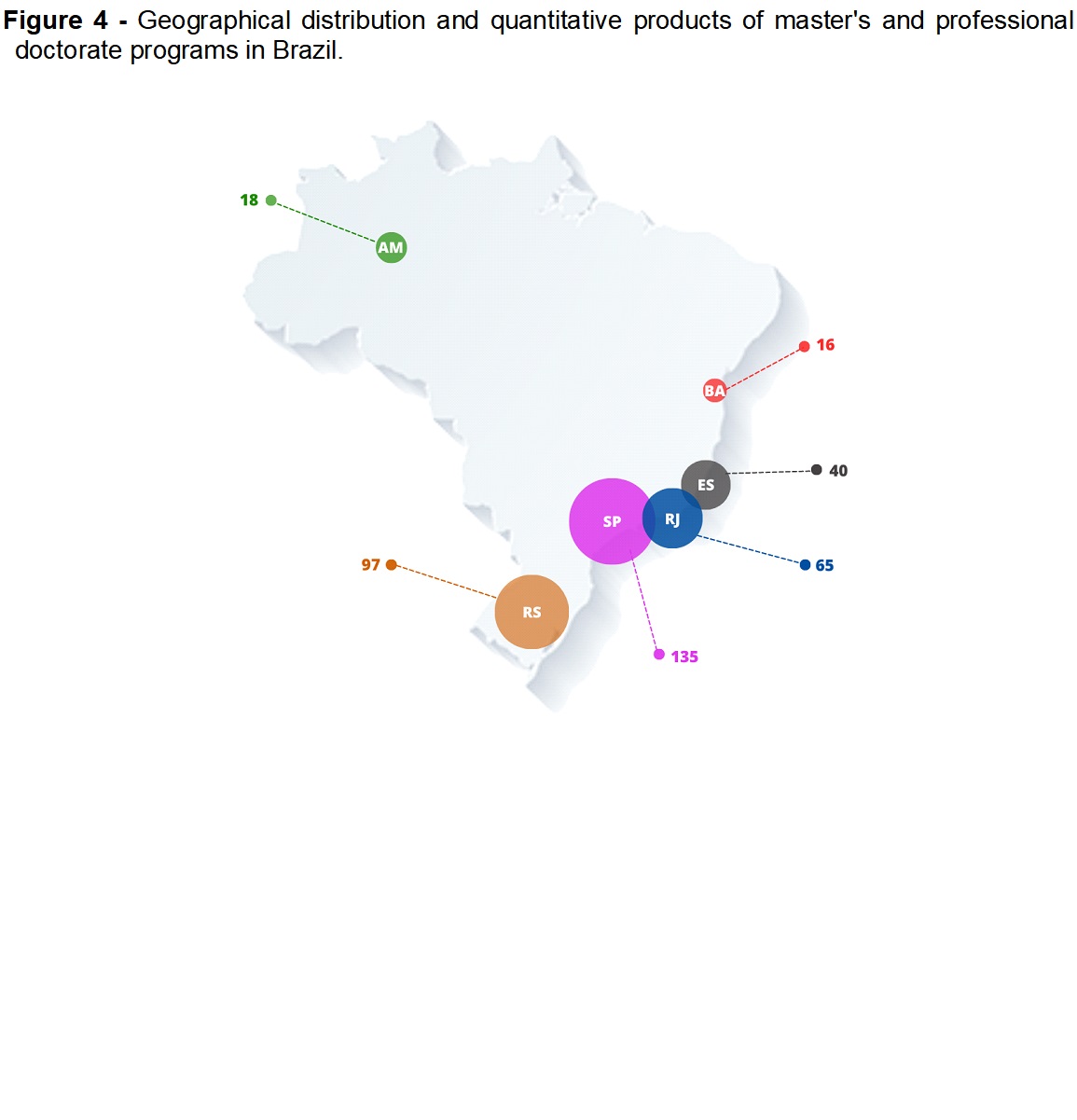
The geographic distribution of the programs and the quantity of products in the respective state were described in figure 4, in which it was observed the predominance of São Paulo with 36.7% of the total studies found, and Rio Grande do Sul with 26.4%. It was also possible to identify that the years with the highest production in total number, in Brazil, were 2017 and 2019, both with 28% (103), followed by 2018 with 25.8% (95).
The sample is mostly composed of product publications concentrated in the years 2017 and 2019. In addition to the annual nature for completion of the programs' grids, globally, a recent increase in interest in professional master's (MP) courses is observed due to the demands of an increasingly diverse and specialized labor market.6-7.
This demand also reflects the fact that these programs provide students with skills that directly apply to gaps in their respective fields, as well as allow for specialization in emerging industries and areas that have not yet been addressed by academia.8
In the discipline of nursing, this factor expands and intensifies. The emerging epidemiological transition in Brazil, which encompasses population aging and an increase in people living with chronic diseases, brings with it a consequent demand for a workforce with more advanced skills.
As a result of these changes, health care facilities are driven to provide appropriately trained and qualified staff who meet the complex and changing needs of patients.9
Although still in short supply, advanced practice nursing is a field that is climbing as a glimpse into the future of the profession and may serve as a lever for increased demand for nurses who specialize in their field. Thus, advanced practice nurses are autonomous in making decisions based on the assessment, diagnosis, and interpretation of test results.9
In this way, to be able to practice with safety and mastery, it is necessary for the professional to have a master's degree and/or doctorate, specific or not, requiring more specialized human resources.10
Among the predominant thematic areas, there is an emphasis on the field of assistance and education. Here, the influence of continuing education as an established value in services is emphasized. In the health sphere, with emphasis on nursing, the search for a continuous and quality educational process in the work environment has been a constant, especially when linked to the promotion and improvement of the technical and scientific competences of the workers.
Continuing education, defined by the National Policy of Continuing Education in Health, is an on-the-job learning, in which learning and teaching are incorporated into the daily routine of the organizations and the work process, and proposes that the education processes of health workers be based on the discussion of practice.11
In this way, investing in a professional master's degree helps to obtain the specialized knowledge that will result in highlights and products focused on your field. Thus, as the workforce evolves, experience and credibility in the sector and in the assistance provided is improved, flowing in a relevant and fruitful way for the nurse and the service.12
In addition, although undergraduates can transition directly into MP programs, they are often aimed at professionals already in the market who wish to develop or change their careers. This aspect makes the programs more flexible and able to respond to the various demands of the same area of the labor market, facilitating the adhesion of those interested.13
We observed the predominance of the Southeast region in the quantity of programs and products, covering, when added together, the states of São Paulo, Rio de Janeiro, and Espírito Santo, about 65.3% of the sample. This result is linked to an economic and sociodemographic phenomenon that justifies a concentration of scientific production in the southeastern states.
The new academic transnational mobilities and paradigms are more informative about the nature and character of this result, since the southeastern region is consecrated as still endowed with the industrial concentration and active labor force, according to the most recent data from the Annual Social Information Report.14
Still, this concentration indicates a migration process of labor and academic activity, driven by some factors, among which is intellectual migration. This phenomenon is the migration of higher education students and highly qualified professionals for career purposes, given the amplitude of the labor market, the quality of the institutions, and the quantity and diversity of the vacancies offered by them, with greater chances and better perspectives regarding the recognition of the professional's qualification.15
It is important to point out that a reflection study points out professional master's degrees as a modality with the potential to weaken the development of nursing research.16 In the analysis of dissertations from MP, the opposite of this view is perceived, considering the increase in demand for this modality and the credibility that the programs have, being offered by the best universities in the country, in all Brazilian regions.
The construction of product and process technologies predominated, such as primers, manuals, protocols, and software. These products are directed, in short, to specific care possibilities of a reality, which have the direction to guide the work processes in health and nursing.17-18.
The contributions of the creation of products and technological innovations to the improvement of safe care and the appreciation and encouragement of ideas that bring possibilities for improving work processes are highlighted. No potentially influential sources were identified as possible conflicts of interest.
Thus, the social contribution of this research is based on the offer of an analysis of the panorama of professional masters and doctoral degrees in nursing, those who have a clear need to bring health care inquietudes to the academic environment. The strengthening of this relationship has the potential to improve the quality of care practices and, consequently, to offer safer and more qualified care to society.
The contributions of this study to nursing are considered, as discussing the products resulting from professional masters and doctorates broadens the view of how this teaching modality is characterized and, also, reflects on the reduction of the distance between research and care. In addition, it contributes scientifically to the existing gap in the literature about this object of study.
This study presents limitations that cross the scientific gap about the theme, considering the lack of research and debates related to professional masters and doctorates and their repercussions on the development of Nursing.
This study aimed to describe and characterize the panorama of stricto sensu training in nursing in the context of professional master's degrees and doctorates. The sample was composed of dissertations that were predominantly from the area of education, followed by adult health, Systematization of Nursing Care, Collective Health, and Nursing Management. Such themes are justified by the emerging epidemiological transition in Brazil, which brings with it a consequent demand for a workforce with advanced skills.
It is noteworthy that no products referring to the professional doctorate were found, considering the absence of graduating classes in time for this research.
One must consider the predominance of the construction of product and process technologies in the studies, such as protocols and software, signaling the search for an educational strengthening that results in impacts for the work environment.
Thus, through the analysis of the products, it became evident that graduate nursing programs, in the professional modality, are characterized by promoting studies that enable an improvement of technical-scientific skills and improvement of the possibilities of care in nursing practice.
Santos MMP and Araújo MS contributed to the design, planning, data analysis and interpretation, and writing of the study. Medeiros SM, Oliveira JSA, and Feijão AR contributed to the critical review of the study.
Nothing to declare.
This study is funded by the National Council for Scientific and Technological Development (CNPq- in Portuguese) through a scholarship at the doctoral level.
- Brasil. Presidência da República. Casa Civil. Subchefia para Assuntos Jurídicos. Lei nº 7.498, de 25 de junho de 1986. Dispõe sobre a regulamentação do exercício da Enfermagem e dá outras providências. Diário Oficial da União, 26 jun.1986. Disponível em:ttps://www.camara.leg.br/proposicoesWeb/prop_mostrarintegra?codteor=143707&filename=LegislacaoCitada%20PL%201317/2003.
- Santos GB, Hortale VA, Souza KM, Vieira-Meyer APGF. imilarities and diferences between Academic and Professional Master Programs as Educational Public Policy in the field of Public Health. Ciênc Saúde Colet [Internet]. 2019 [citado 01 out 2022]; 24(3): 941-952. doi: https://doi.org/10.1590/1413-81232018243.30922016
- Coordenação de Aperfeiçoamento de Pessoal de Nível Superior (CAPES). Programa de Flexibilização da Pós-graduação. Brasília: CAPES; 1995.
- Brasil. Portaria n° 80, de 16 de dezembro de 1998. Dispõe sobre o reconhecimento dos mestrados profissionais e dá outras providências. Diário Oficial da União, 11 jan.1999. Disponível em: https://www.normasbrasil.com.br/norma/portaria-80-1998_181234.html.
- Cellard A. Análise documental. In: Poupart JRM, Deslauriers J-P, Groulx L-H, Laperrière A, Mayer R, Pires AP. A pesquisa qualitativa: enfoques epistemológicos e metodológicos. Rio de janeiro: Vozes; 2012. p. 295-316.
- Li W, Lo L, Lu Y, Tan Y, Lu Z. Intellectual migration: considering China. J Ethn Migr Stud [Internet]. 2021 [citado 01 out 2022]; 47(12): 2833-2853. doi: https://doi.org/10.1080/1369183X.2020.1739393
- Santos MA, Luchesi BM, Rivas NPP, Püschel VAA. Pedagogical training in nursing graduate courses in Brazil. Texto Contexto Enferm [Internet]. 2021 [citado 01 out 2022]; 30: 1-17. doi: https://doi.org/10.1590/1980-265X-TCE-2020-0466
- Gimeno-Jordá MJ. Evaluación de la formación especializada en farmacia hospitalaria. Farm Hosp [Internet]. 2020 [citado 01 out 2022]; 5: 198-211. doi: http://dx.doi.org/10.7399%2Ffh.11414
- Rewa T, Miranda Neto MV, Bonfim D, Leonello VM, Oliveira MAC. Práticas avançadas de enfermagem: percepção de egressos da residência e do mestrado profissional. Acta Paul Enferm [Internet]. 2019 [citado 01 out 2022]; 32(3): 254-260. doi: https://doi.org/10.1590/1982-0194201900035
- International Council of Nurses (ICN). Guidelines on Advanced Practice Nursing 2020 [Internet]. Geneva: ICN; 2021 [citado 01 out 2022]. Available from: https://www.icn.ch/system/files/documents/202004/ICN_APN%20Report_EN_WEB.pdf
- Brasil. Ministério da Saúde. Portaria GM/MS nº 1.996, 20 de agosto de 2007. Dispõe sobre as diretrizes para a implantação da Política Nacional de Educação Permanente em Saúde. Brasília (DF): Ministério da Saúde; 2007.Disponível em : https://bvsms.saude.gov.br/bvs/saudelegis/gm/2007/prt1996_20_08_2007.html.
- Machado MH, Koster I, Aguiar Filho W, Wermelinger MMCW, Freire NP, Pereira EJ. Labor market and regulatory processes – Nursing in Brazil. Ciênc Saúde Colet [Internet]. 2020 [citado 01 out 2022]; 25(1): 101-112. doi: https://doi.org/10.1590/1413-81232020251.27552019
- Fialho NH, Hetkowski TM. Professional Master Programs in Education: new perspectives of postgraduate studies in the Brazilian scenario. Educ Rev [Internet]. 2017 [citado 01 out 2022]; 63: 19-34. doi: https://doi.org/10.1590/0104-4060.49135
- Brasil. Ministério do Trabalho. Relação Anual de Informações Sociais (RAIS) do Ministério do Trabalho e Emprego. Brasília: Ministério do Trabalho; 2020.
- Popogme O, Adeosun OTO. Empirical analysis of the push factors of human capital flight in Nigeria. Int J Humanit Appl Soc Sci [Internet]. 2020 [citado 01 out 2022]; 3(4). Available from: https://www.emerald.com/insight/content/doi/10.1108/JHASS-07-2020-0093/full/html
- Severino AJ. The professional master's program: one more mistake in national policy for post-graduation. Rev Educ [Internet]. 2006 [citado 01 out 2022]; 21: 9-16. doi: https://doi.org/10.1590/0034-7167-2020-0007
- Padilha MI, Maliska IA, Costa R, Benedet AS, Gelbcke FL, Anders JC. Professional master program: Preparing the nurse of the future. Rev Bras Enferm [Internet]. 2020 [citado 01 out 2022]; 73(5). doi: https://doi.org/10.1590/0034-7167-2020-0007
- Ferreira RE, Tavares CMM. Analysis of the technological production of three professional master’s programs in the field of nursing. Rev Latino-Am Enfermagem [Internet]. 2020 [citado 01 out 2022];28. doi: http://dx.doi.org/10.1590/1518-8345.3916.3276
Correspondence
Marina Marisa Palhano dos Santos
E-mail: palhanomarina@gmail.com
Submitted: 02/01/2023
Accepted: 04/24/2023
Published: 12/20/2023
Section Editor: Thaís Araújo da Silva
Scientific Editor: Tatiane Gomes Guedes
Editor-in-Chief: Maria Wanderleya de Lavor Coriolano-Marinus
Copyright© 2023 Revista de Enfermagem UFPE online/REUOL.
This is an open-access article distributed under the CC BY 4.0Creative Commons Attribution-ShareAlike 4.0 International License, which permits others to distribute, remix, adapt, and create from your work, even for commercial purposes, if they credit you for the original creation. It is recommended to maximize the dissemination and use of licensed materials.
 Português (Brasil)
  English
  Español (España)