Idioma
Stages in the practice of investigating adverse events: a snapshot of the national scenario
INTRODUCTION
Risk management consists of the systemic and continuous application of policies, procedures, conduct and resources in the identification, analysis, evaluation, communication and control of risks and adverse events that affect safety, human health, professional integrity, the environment and institutional image. Furthermore, with the publication of RDC 36/2013, it was possible to understand that risk management has a proactive and reactive approach in health services.1-3
The proactive approach to risks consists of identifying, planning and implementing actions and activities that act as barriers to prevent this risk from resulting in an incident. The reactive approach, on the other hand, consists of managing incidents once the risks have already been identified as an incident, i.e. an event or circumstance that could have resulted or has resulted in unnecessary harm to the patient.3-4
In this context, RDC No. 36 was published in Brazil, which instituted actions for patient safety in health services, as well as the creation of the Patient Safety Committee (NSP in Portuguese).1
The NSP is defined as an instance of the health service created with the aim of promoting and supporting the implementation of actions aimed at patient safety. The NSP's primary function is to integrate the different bodies that work with risks in healthcare institutions, considering the patient as the subject and final object of the healthcare process.3-4
In this sense, in health services, the NSP is responsible for managing and operationalizing the proactive and reactive approach to risk management, such as: identifying, analyzing, evaluating, monitoring, treating and communicating risks.3-5
The great challenge for healthcare institutions is to effectively operationalize the reactive approach to risk management, especially when conducting the process of investigating an adverse event (AE) which, according to the World Health Organization (WHO), consists of a failure that results in harm to the patient as a result of medical care or intervention.3-5
An international study has found that one in four patients admitted to American hospitals has suffered an adverse event. Furthermore, every year in Europe, between 8% and 12% of hospitalized patients experience some kind of damage or injury related to the care they receive.6
In an observational study aimed at characterizing adverse events in an Intensive Care Unit, 152 adverse events were found, with a profile of male patients, young adults, with an average age of 45. The main adverse events identified were: medication errors (29.6%), pressure injuries (21%), unplanned extubation (17%), healthcare-associated infections (15.13%) and loss of tube (9.90%), highlighting the need for ongoing education for professionals in order to sensitize them to report events, and training to reduce the rates of adverse events.7
Recently, the WHO published the Global Action Plan for Patient Safety 2021-2030, which aims to address the elimination of preventable harm in healthcare, as it is estimated that 1 in 10 patients is subject to an adverse event during hospitalization and more recent studies suggest that 134 million events are due to poor and/or unsafe care, which could result in 2.6 million deaths annually.8
In this way, the investigation of adverse events in health services, considered a requirement for the NSP, is a fundamental action to identify and map failures in care and explore the possible causes that led to the incident, outlining action plans to reduce the degree of damage and prevent a possible recurrence.1-3
Currently, there are tools and/or instruments that help to carry out research and thus arrive at a robust analysis and consistent results. The most widely used tools for investigating AE are: Canadian Incident Analysis Framework; Yorkshire Contributory Factors Framework and the London Protocol. However, all the tools have one characteristic in common, the search for the root cause of the AE resulting in the construction of an effective action plan.9-13
It is important to note that in order to obtain a complete and robust investigation, there are points that the tool needs to contain, such as: using the WHO conceptual basis, having a team of experts dedicated to the investigation, exhausting the root cause analysis using quality tools, exhausting the identification of contributing factors, the creation of an action plan aligned with the root cause and the failure mode.11-14
In addition, the framework of the intervention force of the action described, i.e. the capacity of that action to eliminate the failure mode or mitigate the existing risks and, finally, the response that the institution will generate to the EA in line with the just culture.15
Another differential in the investigation process is the participation and validation of the institution's legal department to enable an immediate response regarding the involvement of the family, and in understanding the aspects related to the work process and the professional and the organization's articulation to minimize the legal impact.15-16
Although there are national and international recommendations on the investigation process, there is a need to standardize this practice. This aspect was corroborated by the fact that scientific productions show a gap in knowledge about studies dealing with the operationalization of the reactive approach to risks and the implementation of research tools.11-15
Studies indicate that in developing countries there is still a need to carry out research that can reveal aspects of the contributing factors, because in healthcare institutions the risk of death due to errors during hospitalization or the risk of an AE occurring is still quite high.
Thus, the development of this study contributed to improving the reactive approach and increasing the practice's knowledge of the necessary steps for an adequate investigation in line with scientific productions.
OBJECTIVE
The aim of this study was to describe the stages and respective difficulties faced by NSPs when investigating adverse events in healthcare institutions.
METHOD
This is a cross-sectional, prospective study, with a quantitative approach, carried out in 24 public and private hospitals that have NSPs, distributed in different regions of Brazil. The sample consisted of 95 participants who worked in 24 NSPs in the hospitals selected for the study and who met the following eligibility criteria: exclusive dedication to the NSP, having a university degree in health, and working in incident analysis and investigation. Eight professionals who were absent from their duties between September and November 2019 during data collection were excluded.
Participants were recruited in three stages in August 2021. In the first stage, a video conference was held separately with professionals from each hospital using Google Hangouts software version 80.0.3987.163, with the aim of presenting the study, its objectives, and the informed consent form (ICF). In the second stage, the ICF was sent by e-mail for the participants to review and sign if they agreed to participate in the study. Finally, in the last stage, a link was provided to access the data collection instrument, which was developed using Survey Monkey online software.
Data were collected from September to November 2021 using a structured questionnaire consisting of 14 questions. The questionnaire, based on the recommendations of the National Patient Safety Program (PNSP) and the approach of the tools recommended by national and international accreditation methodologies, contained two parts: questions related to the profile of the professional and information about the institution in which they worked; and questions about the practical steps and recommendations that should be included in the process of investigating adverse events in health care.
The data was organized in Excel® 2011 spreadsheets and analyzed using descriptive statistics. Statistical treatment was carried out using IBM SPSS (Statistical Package for the Social Sciences) software, version 22.0, and R software.
The research complied with all the legal ethical aspects of Resolution 466/2012 of the National Health Council and was approved by the Ethics Committee of the proposing institution, under substantiated opinion number: 3.567.788.
RESULTS
A total of 95 professionals working in the incident investigation process at 24 NSPs in the hospitals selected for the study took part. The majority of the professionals were female (83.2%), aged between 39 and 42 (40.0%), nurses (89.5%), with a postgraduate MBA (61.1%), the first specializing in intensive care (56.8%) and the second in quality management in health services (79%) (Table 1).
Table 1. Characteristics of professionals involved in investigating incidents at the patient safety committee. Rio de Janeiro (RJ), Brazil, 2022.
|
Variable |
Overall (n=95) |
|
|
F |
% |
|
|
Sex |
|
|
|
Female |
79 |
83,2 |
|
Male |
16 |
16,8 |
|
Age (years) |
|
|
|
30 |¾ 33 |
11 |
11,6 |
|
33 |¾ 36 |
15 |
15,8 |
|
36 |¾ 39 |
4 |
4,2 |
|
39 |¾ 42 |
38 |
40,0 |
|
42 |¾ 45 |
13 |
13,7 |
|
45 |¾ 48 |
8 |
8,4 |
|
48 |¾ 51 |
0 |
0,0 |
|
51 |¾ 54 |
6 |
6,3 |
|
Position in the institution |
|
|
|
Quality Analyst/Coordinator/Consultant/Supervisor |
64 |
67,37 |
|
NSP Manager |
15 |
15,79 |
|
Care manager |
8 |
8,42 |
|
Patient Safety Analyst |
5 |
5,26 |
|
Risk consultant/manager |
3 |
3,16 |
|
Professsion |
|
|
|
Nurse |
85 |
89,5 |
|
Biomedical |
3 |
3,2 |
|
Medical |
3 |
3,2 |
|
Pharmacist |
2 |
2,1 |
|
Physiotherapist |
1 |
1,1 |
|
Psychologist |
1 |
1,1 |
|
Highest degree |
|
|
|
Doctorate |
6 |
6,3 |
|
Specialization |
15 |
15,8 |
|
MBA |
58 |
61,1 |
|
Master's Degree |
16 |
16,8 |
|
Number of Specializations |
|
|
|
1 |
32 |
33,7 |
|
2 |
63 |
66,3 |
|
Training path - First specialization |
|
|
|
Infection control |
10 |
10,5 |
|
Oncology |
17 |
17,9 |
|
Intensive Care |
54 |
56,8 |
|
Surgical Center |
3 |
3,2 |
|
Other |
11 |
11,5 |
|
Training path - Second Specialization |
|
|
|
Quality Management in Health Services |
79 |
79,0 |
|
Health Management |
7 |
7,4 |
|
Total Quality Management Patient Safety Health Executive Other |
2 2 3 6 |
2,1 2,1 3,2 6,3 |
|
Time since graduation (years) |
|
|
|
8 |¾ 11 |
11 |
11,6 |
|
11 |¾ 14 |
40 |
42,1 |
|
14 |¾ 17 |
27 |
28,4 |
|
17 |¾ 20 |
5 |
5,3 |
|
20 |¾ 23 |
6 |
6,3 |
|
23 |¾ 26 26 |¾ 29 |
5 1 |
5,3 1,1 |
This study identified how the stages of investigation of adverse events occur in clinical practice, based on the recommendations of the National Patient Safety Program (PNSP). Figure 1 shows this process in the institutions participating in the research.
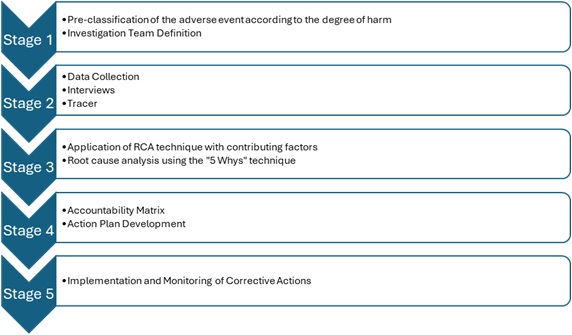
Figure 1. Stages in the investigation of adverse events. Rio de Janeiro (RJ), Brazil, 2022.
Table 2 shows the frequency distribution of the answers to the questions about the steps considered important for investigating adverse events.
Table 2. Responses on the steps considered important for investigating adverse events. Rio de Janeiro (RJ), Brazil, 2022.
|
Question |
N |
% |
|
1) The decision to investigate an adverse event should be defined on the basis of a risk management policy and depend on the degree of damage. |
|
|
|
Strongly Disagree |
15 |
15,8% |
|
Partially agree |
10 |
10,5% |
|
Totally agree |
70 |
73,7% |
|
2) It is important to define a multidisciplinary team to investigate adverse events. |
|
|
|
Partially agree |
15 |
15,8% |
|
Totally agree |
80 |
84,2% |
|
3) An expert in the field should be included to investigate adverse events |
|
|
|
Strongly Disagree |
5 |
5,3% |
|
Partially agree |
5 |
5,3% |
|
Totally agree |
85 |
89,5% |
|
4) At the data collection stage, in some cases it is important to use other resources, such as image (video) recording, voice recording, personnel department records (time sheets) and work schedules. |
|
|
|
Partially agree |
10 |
10,5% |
|
Totally agree |
85 |
89,5% |
|
5) The interview stage should take place after the data collection stage. |
|
|
|
Partially agree |
10 |
10,5% |
|
Totally agree |
85 |
89,5% |
|
6) After data collection and interviews, visit the unit to rework the process/line of care/protocol to identify other aspects that will be included in understanding the failure mode. |
|
|
|
Neither disagree nor agree |
5 |
5,3% |
|
Partially agree |
15 |
15,8% |
|
Totally agree |
75 |
78,9% |
|
7) The investigation team will have to identify all the contributing factors using the Root Cause Analysis (RCA) technique based on all the findings (data collection, interviews and tracer). |
|
|
|
Partially agree |
15 |
15,8% |
|
Totally agree |
80 |
84,2% |
|
8) It is interesting to apply the "5 whys?" technique to the category - contributing factor - that obtained the highest number of selections in order to exhaust the root cause analysis. |
|
|
|
Neither disagree nor agree |
5 |
5,3% |
|
Partially agree |
15 |
15,8% |
|
Totally agree |
75 |
78,9% |
|
9) If the professional factor is found to be a contributory factor in the adverse event, it is important to apply the accountability matrix. |
|
|
|
Neither disagree nor agree |
5 |
5,3% |
|
Partially agree |
15 |
15,8% |
|
Totally agree |
75 |
78,9% |
|
10) Based on the contributing factors, improvement actions will be created using the 5W3H model. |
|
|
|
Totally agree |
95 |
100% |
|
11) The action plan should be categorized according to the strength of the intervention |
|
|
|
Partially agree |
10 |
10,5% |
|
Totally agree |
85 |
89,5% |
|
12) It is important to select an action plan leader to monitor implementation and be the patient safety hub's point of reference for updates. |
|
|
|
Totally agree |
95 |
100% |
|
13) The complete investigation document must be examined by the institution's legal department. |
|
|
|
Strongly Disagree |
5 |
5,3% |
|
Partially agree |
30 |
31,6% |
|
Totally agree |
60 |
63,2% |
|
14) All completed improvement actions should be compiled and presented at leadership meetings |
|
|
|
Partially agree |
20 |
21,1% |
|
Totally agree |
75 |
78,9% |
When asked about the stages in the process of investigating adverse events, the difficulty most often reported by professionals was the stage of following up the Action Plan, with 59 (62%) mentions. In addition, regarding the practice of Disclosure, 90 (94.7%) professionals have already done it and 82 (86.3%) have already given feedback to the notifiers. Finally, 95 (100.0%) professionals consider it important to have a discussion forum with senior management and unit leaders to discuss incidents and improvement plans.
DISCUSSION
In terms of predominance, 85 (89.5%) nurses led the investigation of adverse events in the participating institutions. It can be seen that, over time, nurses have taken on prominent roles, not only in nursing management, but above all in the care management of organizations.17-18
Therefore, this leading and transforming role of nurses in healthcare institutions is due to the fact that the training of this professional, given that the undergraduate nursing course is one of the few that offers theoretical subjects, clinical teaching and curricular internships in the area of Management in its curriculum. This allows future professionals to develop a broader vision of organizational processes, linking management and clinical practice, allowing them to add value to healthcare institutions, especially in terms of the organization's performance.18-19
In terms of the decision to investigate an adverse event being defined on the basis of a management policy and depending on the degree of damage, this reinforces the Canadian model, which begins with the "Preparation for Analysis" stage, consisting of a preliminary investigation. Once the degree of damage is known, in order to determine the appropriate follow-up to an incident, including the need for analysis, an initial investigation or fact-finding is required. After this stage, the "Analysis Process" begins; the Canadian structure offers three types of investigation: concise, comprehensive and multi-incident.12-13
The London Protocol, which consists of a systematized investigation, allows the investigation team to carry out a more in-depth analysis of the incident, based on the organizational accident model. Furthermore, it does not allow a line of investigation based on the degree of damage, because, according to the author, the severity of the outcome is not proportional to the severity of the fault. However, the presence of aggravating and mitigating factors can shape the outcome, and mitigating factors can protect the patient from more serious harm.9-12
It is therefore a complex task, as it involves numerous actions, but it is an important methodology for "exhausting" the analysis of the incident and proposing actions to correct the failures. In addition, it is important to understand the aspects of the contributing factors related to professionals, with the aim of identifying consequences for the second victim, which refers to the professional who suffers emotionally in the face of an unexpected adverse event for patient safety.9,20
Currently, the London Protocol is a tool used to analyze incidents of serious harm and/or death. In some hospitals, the same method is applied in the analysis of death committees after the identification of a preventable death, following the committee's opinion, thus creating a robust and consistent investigation flow.9-11
All the professionals who took part in this study agree on the need to select an action plan leader to monitor implementation and be the patient safety center's point of reference for updating actions. Studies show that, in the nursing sector, work overload and a reduced number of staff contribute to the occurrence of incidents. As a result, the unit manager has a number of managerial and care duties and is unable to adequately monitor and update the action plan.19-21
Furthermore, patient safety management is a commitment for everyone, not just the members of the NSP. For this reason, the greatest difficulty reported is monitoring the action plan. One measure already indicated to improve this process would be the selection of a professional to lead the implementation of the improvement plan resulting from the investigation process.7,20
The role of senior management in validating the findings of the investigation was highlighted, as well as in monitoring improvement actions. This result infers that patient safety involves human resources and decision-making at all levels of the healthcare institution, since a high-reliability organization must have a collective situational awareness of patient safety. Commitment occurs at all levels of the organization, including senior management.21
In this context, it is also worth highlighting the participation of the institution's legal department in assessing all the documents resulting from the investigation process, with the aim of identifying and understanding the failure mode and mitigating the image and legal risks for the institution.
A European study, which aimed to analyze the contribution of medico-legal litigation to clinical risk management and propose a legal intervention model, has led to an understanding of the importance of including this stage in the investigation process, since the evaluation of cases of professional liability, mode of failure, standardization of a list of events associated with legal proceedings can help to identify potential risks of care practice and enrich the information regarding contributing factors and the action plan.17-22
In this context, there is a need to invest in training NSP professionals in order to guarantee a robust investigation, and not just from the point of view of informing the governing and certifying bodies. Some studies have described the challenges inherent in continuing education in health, such as resistance to changing the culture, adherence to activities and high turnover of professionals, especially in the care team.23-24
This study contributes to professionals who investigate adverse events in health services, as it allows us to deepen our knowledge of the steps currently taken and understand the difficulties pointed out by the participants, making it possible to identify new research that will provide scientific knowledge for professionals who work in the practice of incident management.
A limitation of the study was the fact that private institutions predominated among the survey participants. As a result, it was not possible to carry out a comparative analysis of the responses between professionals from public and private institutions, as the sub-group of public institutions had a small sample size.
CONCLUSION
The results of this study have enabled the description of stages and challenges in investigating adverse events within healthcare institutions, while also contributing to a comprehensive understanding of nurses' perceptions of these stages. The main difficulties identified in investigating adverse events include data collection, conducting interviews, tracking, and monitoring action plans. There is a critical need for a risk management policy to guide professionals through necessary steps, alongside active leadership involvement to ensure credibility and sustainability of improvement efforts.
Therefore, it is recommended to further investigate this issue, particularly through clinical studies that can effectively integrate theoretical knowledge with practical application. This approach aims to enhance patient safety by systematically identifying contributing factors and care failures, developing effective and sustainable action plans, and fostering a culture of engagement and fairness.
FINANCING
Financing own.
CONFLICTS OF INTEREST
Nothing to declare.
REFERENCES
- Agência Nacional de Vigilância Sanitária (BR). Gestão de riscos e investigação de eventos adversos relacionados à assistência à saúde [Internet]. Brasília: ANVISA; 2017 [cited 2019 Sep 20]. 94 p. (Série Segurança do Paciente e Qualidade em Serviços de Saúde). Available from: http://portal.anvisa.gov.br/documents/33852/3507912/Caderno+7+-+Gest%C3%A3o+de+Riscos+e+Investiga%C3%A7%C3%A3o+de+Eventos+Adversos+Relacionados+%C3%A0+Assist%C3%AAncia+%C3%A0+Sa%C3%BAde/6fa4fa91-c652-4b8b-b56e-fe466616bd57
- Ministério da Saúde (BR). Agência Nacional de Vigilância Sanitária. Resolução da Diretoria Colegiada nº 36, de 25 de julho de 2013. Institui ações para a segurança do paciente em serviços de saúde e dá outras providências. Diário Oficial da União, 26 jul. 2013; Seção 1. Available from: http://portal.anvisa.gov.br/documents/10181/2871504/RDC_36_2013_COMP.pdf/36d809a4-e5ed-4835-a375-3b3e93d74d5e
- Mello LRG de, Christovam BP, Moreira APA, Moraes EB de, Paes GO, Prates CG. Tools for the investigation of adverse events: scoping review. Rev Esc Enferm USP. [Internet]. 2022 [cited 2023 Apr 29];56:e20210519. Available from: https://www.revistas.usp.br/reeusp/article/view/199475.
- World Health Organization. The conceptual framework for the international classification for patient safety: technical report. version 1.1: final technical report January 2009. Geneva: WHO; 2009 [cited 2019 Sep 20]. Available from: https://apps.who.int/iris/bitstream/handle/10665/70882/WHO_IER_PSP_2010.2_eng.pdf?sequence=1&isAllowed=y
- Bates DW, Levine DM, Salmasian H, Syrowatka A, Shahian DM, Lipsitz S, et al. The Safety of Inpatient Health Care. N Engl J Med [Internet]. 2023 [cited 2023 Feb 20];388(2):142-153. Available from: https://www.nejm.org/doi/full/10.1056/NEJMsa2206117. DOI: 10.1056/NEJMsa2206117
- Souza R, Alencar I, Alves A. Eventos adversos na unidade de terapia intensiva. Rev enferm UFPE on line [Internet]. 2018 [cited 2023 Feb 20];12(1):19-27. Available from: https://periodicos.ufpe.br/revistas/revistaenfermagem/article/view/25205. DOI: https://doi.org/10.5205/1981-8963-v12i1a25205p19-27-2018
- Siman AG, Braga LM, Amaro MO, Brito MJ. Practice challenges in patient safety. Rev Bras Enferm. 2019;72(6):1504–11. Available from: https://www.scielo.br/j/reben/a/xVGnxHjMmX8m5yty3BHTy3f/ DOI: https://doi.org/10.1590/0034-7167-2018-0441
- World Health Organization (WHO). Global patient safety action plan 2021–2030: towards eliminating avoidable harm in health care. Geneva: World Health Organization; 2021 [cited 2019 Sep 21]. Available from: https://portaldeboaspraticas.iff.fiocruz.br/wp-content/uploads/2021/11/9789240032705-eng.pdf
- Taylor-Adams S, Vincent C. Systems analysis of clinical incidents: the London protocol. Clin Risk [Internet]. 2004 [cited 2019 Sep 21];10(6):211-20. Available from: https://journals.sagepub.com/doi/10.1258/1356262042368255. DOI: https://doi.org/10.1258/1356262042368255
- Government of Western Australia. Department of health. Clinical incident management toolkit. Perth: Patient Safety Surveillance Unit, Patient Safety and Clinical Quality Division; 2015.
- Government of Western Australia. Incident Analysis Collaborating Parties. Canadian Incident Analysis Framework [Internet]. Edmonton (AB): Canadian Patient Safety Institute; 2012 [cited 2020 Dec 28]. Available from: https://www.patientsafetyinstitute.ca/en/toolsResources/IncidentAnalysis/Documents/Canadian%20Incident%20Analysis%20Framework.PDF
- Health Service Executive – HSE. Yorkshire contributory factors framework: draft for consultation [Internet]. 2017 [cited 2020 Jul 26]. Available from: https://www.hse.ie/eng/about/qavd/protected-disclosures/incident-management-framework/yorkshire-contributory-factors-framework.pdf
- National Patient Safety Foundation. RCA2: Improving root cause analyses and actions to prevent harm. [Internet]. Boston, MA: National Patient Safety Foundation; 2015. [cited 2020 Jul 26]. Available from: https://www.ashp.org/-/media/assets/policy-guidelines/docs/endorsed-documents/endorsed-documents-improving-root-cause-analyses-actions-prevent-harm.ashx
- Baratto MA, Seidel EJ, Morais BX, Munhoz OL, Silva SC, Zotelle C, et al. Patient safety culture: perspective of health and support workers. Acta Paul Enferm. 2021;34:eAPE001595. Available from: https://www.scielo.br/j/ape/a/SQfxWbtYGC5tMfXvhgFsrRS/?lang=en DOI: https://doi.org/10.37689/acta-ape/2021AO001595
- Prates CG, Magalhães AMM, Balen MA, Moura GMSS. Núcleo de segurança do paciente: o caminho das pedras em um hospital geral. Rev gaúcha enferm [Internet]. 2019 [cited 2020 Jul 26];40(esp):e20180150. Available from: https://www.scielo.br/j/rgenf/a/D56fnMg49q9vyFGXRxKVPqz/?format=pdf&lang=pt. DOI: https://doi.org/10.1590/1983- 1447.2019.20180150
- Bogarin DF, Zanetti ACB, Brito MFP, Machado JP, Gabriel CS, Bernardes A. Patient safety: knowledge of undergraduate nursing students. Cogitare Enferm [Internet]. 2014 [cited 2021 Oct 14];19(3). Available from: https://revistas.ufpr.br/cogitare/article/view/33308/23222. DOI: http://dx.doi.org/10.5380/ce.v19i3.33308
- Silva ACAB, Santa Rosa DO. Patient safety culture in hospital organization. Cogitare Enferm [Internet]. 2016 [cited 2021 Oct 14];21(5). Available from: https://revistas.ufpr.br/cogitare/article/view/45583/pdf_1. DOI: http://dx.doi.org/10.5380/ce.v21i5.45583
- Mello LRG, Christovam BP, Araujo MC, Moreira APA, Moraes EB, Paes GO, et al. Patient safety centers: profile of human resources in the Brazilian scenario. Acta Paul Enferm [Internet]. 2021 [cited 2021 Dec 14];34:eAPE001165. Available from: http://old.scielo.br/pdf/ape/v34/en_1982-0194-ape-34-eAPE001165.pdf. DOI: https://doi.org/10.37689/acta-ape/2021ao001165
- Bolcato M, Fassina G, Rodriguez D, Russo M, Aprile A. The contribution of legal medicine in clinical risk management. BMC Health Serv Res [Internet]. 2019 [cited 2020 Jul 26];19(85):1-6. Available from: https://bmchealthservres.biomedcentral.com/articles/10.1186/s12913-018-3846-7#citeas. DOI: https://doi.org/10.1186/s12913-018-3846-7
- Alevi JO, Draganov PB, Gonçalves GC de S, Zimmermann G dos S, Giunta L, Mira JJ, et al.. O enfermeiro recém-formado na condição de segunda vítima. Acta paul enferm [Internet]. 2024;37:eAPE02721. Available from: https://doi.org/10.37689/acta-ape/2024AO0002721
- Lanzoni GMM, Meirelles BHS. Leadership of the nurse: an integrative literature review. Rev latinoam enferm [Internet]. 2011 [cited 2020 Apr 11];19(3):651-8. Available from: https://www.scielo.br/j/rlae/a/874h8WQ98FHQTfK4z6WCgxr/?format=pdf&lang=en. DOI: https://doi.org/10.1590/S0104-11692011000300026
- Jiménez-Gómez MA, Cárdenas-Becerril L, Velásquez-Oyola MB, Carrillo-Pineda M, Barón-Díaz LY. Reflective and critical thinking in nursing curriculum. Rev latinoam enferm [Internet]. 2019 [cited 2020 Apr 11];27:e3173. Available from: https://www.scielo.br/j/rlae/a/pGznbWgnTXBrg6xZSPsyxxt/?format=pdf&lang=en. DOI: https://doi.org/10.1590/1518-8345.2861.3173
- Sanclemente-Vinue I, Elboj-Saso C, Iñiguez-Berrozpe T. The voice of nurses as a means to promote job engagement. Rev latinoam enferm [Internet]. 2019 [cited 2020 Apr 11];27:e3208. Available from: https://www.scielo.br/j/rlae/a/M9fB9qCcbPHjP63LFVtJymF/?format=pdf&lang=en. DOI: https://doi.org/10.1590/1518-8345.3193.3208
- Parente A do N, Ferreira GRON, Cunha CLF, Ramos AMPC, Sá AMM, Haddad M do CFL, et al.. Educação permanente para qualidade e segurança do paciente em hospital acreditado. Acta paul enferm [Internet]. 2024;37:eAPE00041. Available from: https://doi.org/10.37689/acta-ape/2024AO0000041
Correspondence
Lucas Garcia Mello
Email: garcialucas@id.uff.br
Copyright© 2024 Revista de Enfermagem UFPE on line/REUOL.
Este é um artigo de acesso aberto distribuído sob a Atribuição CC BY 4.0 Creative Commons Attribution-ShareAlike 4.0 International License, a qual permite que outros distribuam, remixem, adaptem e criem a partir do seu trabalho, mesmo para fins comerciais, desde que lhe atribuam o devido crédito pela criação original. É recomendada para maximizar a disseminação e uso dos materiais licenciados.
 Português (Brasil)
  English
  Español (España)