Living in Paradise
Keywords:
Fisherwomen, Traditional Communities, Development Anthropology, Major ProjectsAbstract
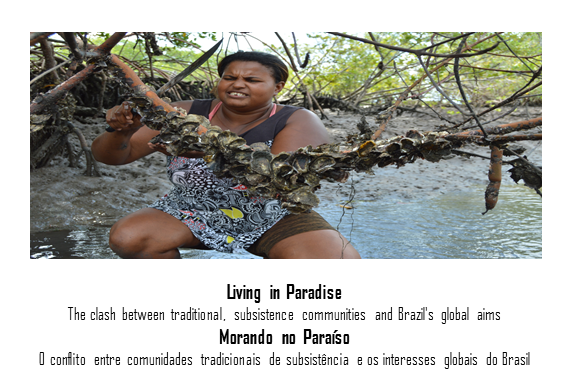
Roughly 5000 women participate in Pernambuco's “straw hat” community education course for fisher women. Unlike their male counterparts, who generally use boats to fish off-shore, the women fisher folk are marisqueiras, shellfish women. They collect mollusks, sand crabs, brown crabs and other shellfish from the tidal mangrove swamps that hug the state's coast. They do the work barefoot since they can sink up to their mid-calves in the muddy terrain. At times, the women will be waist deep or higher in water as they pry mussels from tree branches or coax small crabs out from their shelters among the mangrove roots. For generations, Marisqueiras and their families subsisted on their catch. The women's crabbing generally supplements income men in the household earn on the water or through other work.
Marisqueiras like Valeria Maria de Alcàntara and her sister Vania say that the conditions in the mangrove swamps have deteriorated dramatically over the past several years. They blame expansion at the nearby Suape Port and Industrial Complex, which houses two shipbuilding firms, a coca-cola bottling plant, various chemical companies and other enterprises. The complex sprawls roughly 2 hours south of the state capital, Recife, on a coast known for its beautiful beaches. The complex includes a strategic oil refinery and attracted tens of thousands of workers to the area to build new facilities during the aughts. For some area residents, the expansion has led to job opportunities in the port complex. For many others, Suape's growth has disrupted centuries-old lifestyles and livelihoods. To accommodate its development, the Suape complex has displaced families from their homes and inflicted crippling damage on the mangrove swamps' ecosystem.
But it is the women who are suffering most. Victims of sexual harassment and violence, many women complain that they no longer feel safe in the areas where they have lived their entire lives. The loss of income and sustenance from crabbing exacerbates tensions within the home as well, forcing more women to seek outside employment and burdening family budgets. “Throughout the history of fishing in Brazil, women's activity has been rendered invisible.” Laurinede Maria Santana told me at a conference for traditional fisherfolk. “What these women produce doesn't enter into official fishing statistics,” Santana explained, stating that this government policy marginalizes the women's work. It also makes it impossible to hold officials accountable for income lost to environmental damage.
The Petrobras refinery in the complex was supposed to help Brazil position itself better in the global energy market. Scandals at the state-owned firm and plunging oil prices make it unclear if that calculation will pay off. In the meantime, the fisherwomen and the small-scale farmers who live in the area around the Suape Port and Industrial Complex have been sacrificed like pawns in this global game of chess.
Credits: Zoe Sullivan
Authors: Zoe Sullivan
Photographs: Zoe Sullivan
Direction, image editing and text: Zoe Sullivan
Downloads
Published
Issue
Section
License

This work is licensed under a Creative Commons Attribution-NonCommercial 4.0 International License.
Direitos Autorais para trabalhos audiovisuais publicados na AntHropológicas Visual sã licenciados para uma licenca Creative Commons 4.0 BY-NC.
