Records and moviments not arising fron a hetero-identification process
DOI:
https://doi.org/10.51359/2526-3781.2022.253459Keywords:
Affirmative Action, Public policy, College education, Heteroidentification, Social Quotas.Abstract
This visual essay is part of an experience of participation in a Heteroidentification panel for the implementation of the Quota Law of the Selective Process of the Federal University of Pará (UFPA), Brazil, developed between February and March 2022. The selection processes that involve heteroidentification panels are part of the strategies of the Quota Law that subsidize the entry of blacks into universities (BRASIL, 2012), given that at times there was an exclusive use of self-declaration by the candidate, a model that was evidenced by some weaknesses (SANTOS, 2018). There is no doubt that there is a great debate about racial quotas and hetero-identification boards, as there are many issues that involve the formation of Brazilian society, such as racism and its denial (NUNES, 2018).
In the past, as an inspection mechanism, it has guided an effective movement against fraud and/or fraud attempts, as well as its very constitution/presence inhibits possible fraud attempts (SANTOS, 2021). Furthermore, it is necessary to consider regional specificities such as cultural issues and miscegenation, facts observed in the profiles of the North region. Some studies have already pointed out some difficulties in managing the heteroidentification process, which should guide future selections (ELÍSIO et al, 2019; BATISTA & FIGUEIREDO, 2020; SANTOS, 2021).
On the other hand, the movement created by the Law of Quotas brings new dynamics to the university. Firstly, with the Federal Law of Quotas, the reservation of vacancies in Higher Education Institutions (HEIs) reaches 50%, which allows the entry of black people or black people of mixed color and indigenous people (BRASIL, 2012). Another important moment in the case of UFPA is that, for the first time, the commission carried out its evaluation in a 100% face-to-face manner at the same time as the return to classes in the face-to-face modality after 24 months of the COVID-19 pandemic.
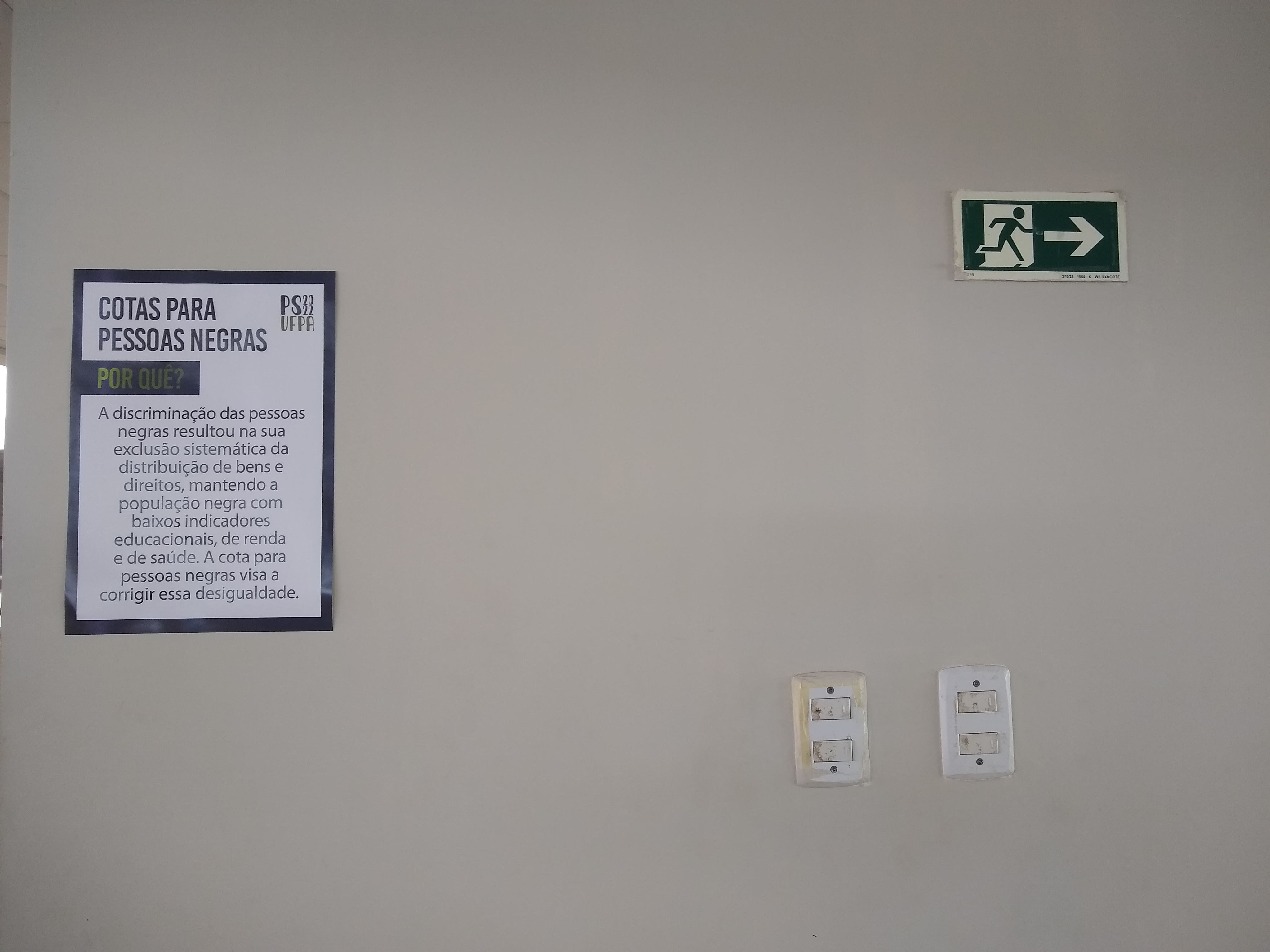
The essay's records bring the movements observed along the building spaces reserved for the qualification and hetero-identification process in the 2022 Selection Process. pandemic period and, above all, representative of black and brown people. The occupation of spaces was carried out by student movements, black people, academic groups, families and individuals waiting for the result of the qualification and hetero-identification process.
The symbols that make up the space such as identifications, posters, chair and gestures identify the paths to the room that makes up the selection, which in the case of UFPA were 8 commissions with 5 members each. Members were similar to committees from other HEIs and had compositions of participating subjects with different profiles and representations (SILVA et al, 2020). Furthermore, it is emphasized that the process of heteroidentification symbolizes social and political involvement and critical reflection for training in higher education.
The activities were recorded using a field diary for the purpose of recording the experience and composing the narrative.
References
BATISTA, N.C; FIGUEIREDO, H. A. C. Comissões de Heteroidentificação racial para acesso em Universidades Federais. Cadernos de Pesquisa [online]. 2020, v. 50, n. 177; pp. 865-881. Disponível em: https://doi.org/10.1590/198053147264.
BRASIL. Lei n. 12.711, de 29 de agosto de 2012. Dispõe sobre o ingresso nas universidades federais e nas instituições federais de ensino técnico de nível médio e dá outras providências. Diário Oficial da União, Brasília, DF, 2012.
ELÍSIO, R.R; COSTA, A. C. M; RODRIGUES FILHO, G. Histórico e Desafios no Processo de Implementação das Comissões de Heteroidentificação na Universidade Federal de Uberlândia. Revista da ABPN, v. 11, n. 29, p. 41-56, 2019.
SANTOS, S. A. Comissões de Heteroidentificação ÉtnicoRacial: lócus de constrangimento ou de controle social de uma política pública?. O Social em Questão, v. 24, n. 50, p. 11-62, 2021.
SANTOS, F. D. Prefácio. In: DIAS, G.R.M; TAVARES JÚNIOR, P.R.F.T. Heteroidentificação e cotas raciais: dúvidas, metodologias e procedimentos. Canoas: IFRS Campus Canoas, 2018. 267p.
NUNES, G.H.L. Autodeclarações e comissões: responsabilidades procedimental dos/as gestores/as de ações afirmativas. In: DIAS, G.R.M; TAVARES JÚNIOR, P.R.F.T. Heteroidentificação e cotas raciais: dúvidas, metodologias e procedimentos. Canoas: IFRS Campus Canoas, 2018. 267p.
Published
Issue
Section
License
Copyright (c) 2022 AntHropológicas Visual

This work is licensed under a Creative Commons Attribution-NonCommercial 4.0 International License.
Direitos Autorais para trabalhos audiovisuais publicados na AntHropológicas Visual sã licenciados para uma licenca Creative Commons 4.0 BY-NC.
