Idioma
Nursing workload associated with pressure injury in critical patients: prospective cohort
Nursing workload associated with pressure injury in critical patients: prospective cohort
Carga de trabalho de enfermagem associada à lesão por pressão em pacientes críticos: coorte prospectivo
ABSTRACT
Objective: to verify the association between the occurrence of Pressure Injury (PI) and the Nursing workload in an Intensive Care Unit (ICU) prospectively. Method: prospective cohort study, carried out in an ICU of a Brazilian teaching hospital. Patients admitted without PI were prospectively evaluated until they developed it or not, to assess associated factors, using, in addition to clinical evaluation, the instruments: Simplified Acute Physiology Score 3, Nursing Activities Score, and Braden Scale. A logistic regression model was developed considering the dependent variable the occurrence of pressure injury yes or no. Results: the incidence of PI was 34%. In the univariate analysis, the variables hemodynamic instability, age, Simplified Acute Physiology Score 3, and the Nursing Activities Score were related to the occurrence of PI. From the logistic regression analysis, only the Nursing Activities Score which measures the Nursing workload was identified as a factor associated with the occurrence of PI. Each Nursing Activities Score point increased the chance of PI by 1.22 times. Conclusion: the Nursing workload was the only independent risk factor associated with the occurrence of this event.
Descriptors: Workload; Nursing; Critical Care; Pressure Injury; Patient Safety.
RESUMO
Objetivo: verificar a associação entre a ocorrência de Lesão por Pressão (LP) e carga de trabalho de Enfermagem em Unidade de Terapia Intensiva (UTI) prospectivamente. Método: estudo de coorte prospectivo, realizado em uma UTI de um hospital universitário brasileiro. Os pacientes admitidos sem LP foram avaliados prospectivamente até o desenvolvimento ou não da mesma, para a avaliação dos fatores associados, utilizando além da avaliação clínica, os instrumentos: Simplified Acute Physiology Score 3, Nursing Activities Score e Escala de Braden. Foi desenvolvido um modelo de regressão logística considerando a variável dependente a ocorrência de lesão por pressão sim ou não. Resultados: a incidência de LP foi de 34%. Na análise univariada, as variáveis instabilidade hemodinâmica, idade, Simplified Acute Physiology Score 3 e o Nursing Activities Score se associaram à ocorrência de LP. A partir da análise de regressão logística, apenas o Nursing Activities Score que mensura a carga de trabalho de Enfermagem foi identificado como fator associado à ocorrência de LP. Cada ponto Nursing Activities Score aumentou a chance de LP em 1,22 vezes. Conclusão: a carga de trabalho de Enfermagem foi o único fator de risco independente associado à ocorrência deste evento.
Descritores: Carga de Trabalho; Enfermagem; Cuidados Críticos; Lesão por Pressão; Segurança do Paciente.
INTRODUCTION
In Intensive Care Units (ICU), the occurrence of Pressure Injury (PI) is one of the most prevalent adverse events. A study developed in 90 countries, including Brazil, with 1,117 ICUs, identified a prevalence of ICU-acquired PI of 16.2%1. A systematic review, conducted with a sample of 2,579,049 patients, identified a prevalence of 12.8%.2
In the national context, a prospective multicenter study involving 1,937 patients detected an incidence rate of PI of 10% in public hospital ICUs and 5.7% in private hospitals.3
Pressure injuries place a substantial financial burden on healthcare systems. In the United States, the average incremental cost attributable to PI is US$ 867, which represents about 7.3% of the value of a hospital admission.4 Given the high occurrence of these events and their impact on costs and patient morbidity and mortality, it is considered an indicator of patient safety and quality of care.5-6
The identification of factors associated with the occurrence of PI in intensive care patients is necessary to enable the implementation of risk-based preventive measures7. Several intrinsic and extrinsic factors have been pointed out, and recently, the Nursing workload has been included as an element that can contribute to the occurrence of PI.8
Workload is a predictor of labor-related injury in critically ill patients based on retrospective evidence from literature studies that point to its association with the occurrence of labor-related injury in ICUs. A retrospective cohort study analyzing medical and nursing records in nine Brazilian ICUs identified workload as a predictor of labor-related injury.5 Moreover, workload is a modifiable factor and, therefore, can be the target of preventive interventions to reduce the risk of developing PI in critically ill patients, which emphasizes the importance of investigating such variable in prospective studies, thus justifying the choice of the Nursing workload variable among the predictors of PI.
It is important to emphasize that the occurrence of PI through records may have limitations, making the daily monitoring of the event's evolution and occurrence essential. Thus, this study aimed to verify the association between pressure injury occurrence and nursing workload in an Intensive Care Unit prospectively. Additionally, the specific objectives were to calculate the overall incidence coefficient of PI and to identify the number and location of PI incidence.
OBJECTIVE
To verify the association between pressure injury occurrence and nursing workload in an Intensive Care Unit prospectively.
METHOD
This is a prospective cohort study conducted in a nine-bed ICU of a Brazilian university hospital, with patient recruitment and follow-up throughout 2017. This study was conducted based on the recommendations of the STROBE (Strengthening the Reporting of Observational Studies in Epidemiology) checklist. The research investigated patients aged 18 years or older, admitted to an ICU for clinical or surgical treatment, being their first admission to the unit and with a minimum stay of 24 hours.
The inclusion of patients in the study occurred after evaluating them upon their admission to the ICU, by means of a cephalocaudal physical examination using the technique of inspection and palpation of the skin to check its integrity. Patients who presented PI and skin alterations such as blisters, urticaria, erosions, vesicles, and/or ulcers were excluded.
The patients included in the study were submitted to daily skin inspection and palpation, during the entire ICU stay until discharge or death, only by the responsible researcher, with clinical experience in critical patient care. Patients who developed PI continued to be followed up to assess the outcome and/or development of new lesions.
The clinical evaluation consisting of inspection and palpation was performed every day, all body surfaces were exposed, preferably at bath time, and all bony prominences were evaluated, always by the responsible researcher, to avoid biases.
The variables of interest in the study were demographic and clinical data, Body Mass Index (BMI), Simplified Acute Physiology Score 3 (SAPS 3), Nursing Activities Score (NAS), and Braden Scale. These variables were listed based on the literature, for being of interest in the development of PI in ICU.
For the characterization of PI, the National Pressure Ulcer Advisory Panel9 classification was used: Stage 1; Stage 2; Stage 3; Stage 4; Non-stageable PI, and Deep Tissue PI. And the additional definitions: Medical Device-Related PI and Mucous Membrane PI.
Demographic and clinical data were obtained from each patient's electronic medical record (age, gender, skin color, length of hospital stay prior to ICU admission, length of ICU stay, hemodynamic instability on admission, and respiratory failure on admission).
The categorization of skin color was based on the Demographic Census 2019 classification system of the Brazilian Institute of Geography and Statistics (IBGE): white; black; brown; yellow; indigenous and undeclared.10
The BMI calculation, performed upon the patient's admission to the ICU, used the formula weight (kg) / height² (m²) and the international BMI classification was adopted, with a BMI value of 18.5 - 24.9 being considered normal.11
Hemodynamic Instability has been associated with unstable blood pressure, especially hypotension, or more broadly associated with inadequate global or regional perfusion. The clinical condition in which patients require vasoactive drugs and/or cardiovascular support.12
Respiratory failure was considered when there was an inability of the respiratory system to adequately perform gas exchange, i.e., to promote oxygenation and elimination of carbon dioxide. The patients require invasive or non-invasive ventilatory support.13
Structured instruments were used for data collection. Among them, the Simplified Acute Physiology Score 3 (SAPS 3) is the tool that estimates the severity of the disease and predicts hospital mortality. The score ranges from zero to 217 points, and the higher the score, the greater the severity14. The instrument was applied 24 hours after admission, calculated based on the worst physiological data of these hours by the medical team, and inserted into the patient's electronic medical record.
The Nursing Activities Score (NAS) used to measure the Nursing workload is composed of 23 items and 32 care activities. The score corresponds to the percentage of time of direct and indirect assistance performed in a 24-hour period.15 The prospective NAS was measured once a day, throughout hospitalization, by the researcher through clinical assessment and direct observation of inpatients and compared to the retrospective NAS collected by the unit's professionals. The values obtained retrospectively indicate the total hours provided to the patients. Its prospective application provides subsidies for preparing the care plan and provides more reliable results to measure the hours of care in the next 24 hours.16 The mean of the prospective NAS was chosen since there was no difference between the prospective and retrospective NAS.
The Braden Scale used to measure the risk for PI is made up of six parameters, and the assessment occurs through its subscales: 1- sensory perception; 2- humidity; 3- activity; 4- mobility; 5- nutrition; 6- friction and shear. The total score can vary from 6 to 23 points. The lower the score, the higher the risk of developing PI, being classified as follows: very high risk (scores equal to or lower than 9), high risk (scores from 10 to 12 points), moderate risk (scores from 13 to 14 points), low risk (scores from 15 to 18 points), and no risk (scores from 19 to 23 points). Braden Scale score 18 was adopted as the cut-off point for PI risk, as recommended in the literature.17-18 The Braden scale was applied and measured by the researcher at admission and every 48 hours.
Statistical analysis was performed using Stata SE® software version 14.0 (CollegeStation, TX). Data were described using median, maximum, and minimum values. Univariate analysis was performed, and Fisher's exact test was used for the dichotomous variables. The Mann-Whitney test was used for quantitative variables since they did not follow a normal distribution. The significance level (α) was considered to be 5%. Variables with a p-value less than 0.20 were included in the logistic regression model. The dependent variable of the logistic regression model was the occurrence of PI (yes or no).
This study was approved by the Research Ethics Committee of the Ribeirão Preto School of Nursing of the University of São Paulo (EERP / USP), Ribeirão Preto / SP, Brazil (CAAE nº 57221516.5.3001.5440).
RESULTS
Regarding the inclusion of patients, figure 1 presents the data.
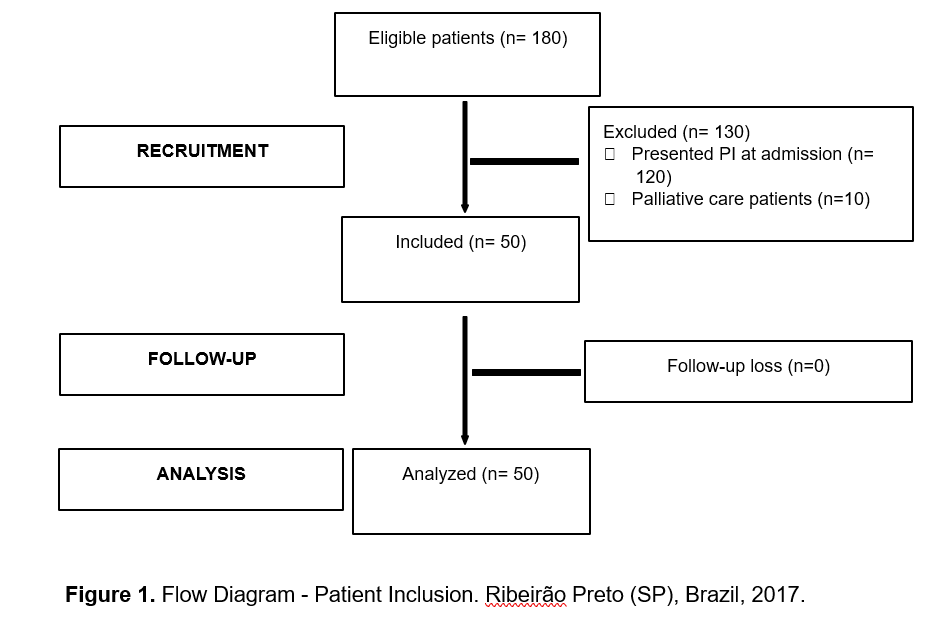
Fifty patients who met the study's selection criteria were included, and of these, 17 developed PI, characterizing an overall incidence coefficient of 34%. These patients developed 21 PI.
In table 1 it is possible to observe the qualitative demographic and clinical variables, and only the hemodynamic instability variable was associated with PI occurrence.
Table 1. Qualitative demographic and clinical variables of patients in an ICU of a large hospital according to the presence (n =17) or not (n = 33) of PI, Ribeirão Preto (SP), Brazil, 2017.
|
Variables |
No injury n (%) |
With injury n (%) |
p-value* |
|
Sex |
|
|
0.322 |
|
Female |
23 (69.70) |
10 (58.52) |
|
|
Male |
10 (30.3) |
7 (41.18) |
|
|
Skin Color |
|
|
0.608 |
|
White |
23 (69.7) |
12 (70.59) |
|
|
Black |
10 (30.3) |
5 (29.41) |
|
|
Body mass index |
|
|
0.43 |
|
Within the normal range (18.5 to 24.9) |
14 (42.42) |
6 (35.29) |
|
|
Not normal (below 18.5 and above 24.9) |
19 (57.58) |
11 (64.71) |
|
|
Respiratory insufficiency |
|
|
0.28 |
|
Yes |
14 (42.42) |
5 (29.41) |
|
|
No |
19 (57.58) |
12 (70.59) |
|
|
Hemodynamic instability |
|
|
0.005 |
|
Yes |
06 (18.18) |
10 (58.82) |
|
|
No |
27 (81.82) |
07 (41.18) |
|
|
Braden score |
|
|
0.43 |
|
Risk of Injury (score of 6-18) |
31 (93.94) |
17 (100) |
|
|
No risk of injury (score 19-23) |
2 (6.06) |
0 |
|
*Fisher's exact test
Table 2 shows the quantitative demographic and clinical variables, where age, SAPS 3 score, and NAS were associated with the occurrence of PI.
Table 2. Demographic and quantitative clinical variables of patients in an ICU of a large hospital according to the presence (n =17) or not (n = 33) of PI, Ribeirão Preto (SP), Brazil, 2017.
|
Variables |
Minimum-Maximum |
Median |
p-value* |
|
Age (in years) No injury With injury |
20.1-81.6 27.8-93.9 |
45.5 54.9
|
0.009 |
|
Length of stay before ICU (days) No injury With injury |
1-44 4-68 |
9 13 |
0.163 |
|
Length of stay in ICU (days) No injury With injury |
1-20 2-14 |
5 6 |
0.991 |
|
SAPS 3 score No injury With injury |
24-91 38-105 |
51 78 |
<0.001
|
|
NAS No injury With injury |
70-97 76-105 |
86 96 |
<0.001 |
* Mann-Whitney U-test; ICU - Intensive Care Unit; SAPS 3 - Simplified Acute Physiology Score 3; NAS - Nursing Activities Score
The identification of factors associated with PI was based on the logistic regression analysis, having as dependent variable the occurrence of PI (yes or no) and as independent variables all the variables that presented a p-value lower than 0.20 in the univariate analysis. In this analysis, only the NAS variable that measures the nursing workload was associated with the occurrence of PI. According to the logistic regression analysis, each NAS point increased the chance of PI by 1.22 times.
Hemodynamic instability, age, and SAPS 3 score variables lost their association effect in this model. Possibly, patients with greater hemodynamic instability, older and of greater severity, are also those with greater nursing workload. The logistic regression model is presented in table 3.
Table 3. Logistic regression model with occurrence of PI as dependent variable, Ribeirão Preto (SP), Brazil, 2017.
|
Variables |
Odds ratio |
95% Confidence Interval |
|
Age |
1.034 |
0.984-1.087 |
|
Hemodynamic instability |
0.513 |
0.073-3.599 |
|
SAPS 3 score |
1.019 |
0.963-1.078 |
|
Length of stay prior to ICU |
1.009 |
0.946-1.075 |
|
NAS |
1.221 |
1.040-1.434 |
ICU - Intensive Care Unit; SAPS 3 - Simplified Acute Physiology Score 3; NAS – Nursing Activities Score
The identification of the affected regions and their frequency, presented in table 4, was also the object of this study, in the group of patients who developed PI.
The lesions developed from the 2nd to the 14th day of the patient's stay in the unit.
Table 4. Distribution of the number of PI in patients of an ICU of a large hospital, according to body region, Ribeirão Preto (SP), Brazil, 2017.
|
Body Area |
N |
% |
|
Gluteals |
08 |
38 |
|
Calcaneus |
04 |
19 |
|
Intergluteal |
03 |
14 |
|
Sacral |
02 |
9.5 |
|
Trochanter |
01 |
5 |
|
Scapular |
01 |
5 |
|
Upper Lip |
02 |
9.5 |
|
Total |
21 |
100.00 |
DISCUSSION
Pressure injuries are a real and growing problem in health services, despite the significant advances in technology in this area, challenging institutions and professionals to deal with them.
During this investigation, an overall incidence rate of 34% was identified, detecting the development of PI in seventeen patients. Such a rate can be considered high when compared to Brazilian studies developed with critically ill patients. A retrospective cohort study conducted in nine public ICUs identified the occurrence of PI in 143 patients, denoting an incidence of 18.7%5. The research conducted in 10 ICUs with 332 patients through a prospective cohort showed the occurrence of PI in 45 patients, with an incidence of 13.6%.19
In the international scope, a systematic review with meta-analysis included twenty-two studies on the incidence and prevalence of PI in adult intensive care patients. The researchers found 10 studies that assessed a cumulative incidence of PI from 10.0 to 25.9%. In studies that used skin inspection to identify PI, the cumulative incidence was 9.4 to 27.5%20. A prospective cohort study of 335 patients admitted to ICUs in Spain for at least 24 hours and followed up for a maximum of 32 days, identified a PI incidence of 8.1%.21
The great variability in PI incidence presented in the studies may be due to the different patient profiles and clinical conditions evaluated, the quality of care provided, the presence of prevention protocols, and especially the diverse study designs and methods, implying caution regarding the generalization and comparison of results.5
Among the patients studied, most were women (n= 33), and 30% of them had PI. There is no consensus on the gender variable in the etiology of PI since it is not a significant independent factor for their appearance, being presented as a demographic characteristic that complements a complex interaction of triggering factors of this lesion22. When assessing the patients' skin colors, the percentage of white and black patients who developed PI was equivalent, diverging from the findings of other studies that identified the white color as a factor associated with the occurrence of the event.23-24
The literature presents divergences regarding the association between age and the development of PI. In this study, age was a factor associated with the occurrence of PI in the univariate analysis (p=0.009), however, it did not show statistical significance in the logistic regression model. A prospective worldwide study, Decubitus in Intensive Care Units (DecubICUs), carried out with adult ICU patients in six continents covering ninety countries, measured the occurrence of PI by direct observation. Age was an independent factor associated with ICU-acquired PI in the generalized linear mixed-effects regression model.1 Similarly, when assessing the age variable in an epidemiological cohort of a prospective multicenter study in southern Brazil, 55.5% of patients with PI were older than 65 years, however, it was not a factor associated with the occurrence of PI.19.
As for BMI values measured at the time of patient admission, those with altered BMI (<18.5 and >24.9), were those with a higher incidence of PI, however such variable did not reach statistical significance. Studies indicate that both obesity and malnutrition are factors that interfere in the development of PI, however, these are considered to occur and be more severe in undernourished or malnourished patients.25-26
The use of BMI as a marker of the nutritional status of critically ill patients should be approached with caution, since the variable body weight used for this calculation, at the time of admission, may be overestimated considering the presence of edema.
In this study, the duration of patients' stay in the ICU was not relevant to the occurrence of PI. This finding differs from other studies that indicate the length of stay as an important risk factor for the development of PI in critically ill patients.7,22
The results indicate that PI usually develop within the first two weeks of hospitalization in critical care units1,27-28, which is in agreement with these findings. Regarding the affected area, literature data indicate the sacral area as the most frequent location for PI occurrence1,21, contrary to the present study's findings, in which the gluteal region predominated.
Among the reasons for patients' admission to the ICU, hemodynamic instability showed a significant association with the development of PI in the univariate analysis (p= 0.005) however was not sustained in the logistic regression analysis. Patients with this clinical status need vasoactive drugs or cardiovascular support and have their mobilization reduced. An analysis of the PhysioNet MIMIC-III (Medical Information Mart for Intensive Care) clinical database aimed to measure the current level of factors evidence associated with the development of PI in critically ill patients. Hypotension and norepinephrine administration were significant predictors.26
An investigation conducted in a medical-surgical ICU of a university medical center in Lebanon, through a retrospective medical record review, also showed that vasopressor agents and hypotension were associated with a higher likelihood of developing PI27.
Patients with higher severity levels are predisposed to the use of vasoactive drugs, mechanical ventilation, sedation, use of several invasive devices, among other changes. Thus, the severity index was a relevant marker in this research and proved to be related to PI development (p = <0.001) in the univariate analysis, not remaining a risk factor in the regression analysis. A Brazilian study carried out in a general ICU of a public hospital, identified a mean SAPS 3 in the group with PI of 55.3 points (Standard Deviation - SD: 22.4) versus 39 (SD: 23) in the group without ulcers, p=0.09.28
Braden scale score in this investigation was not a predictor of PI (p = 0.430). Results in a retrospective cohort of more than five thousand patients from a surgical ICU in a trauma center and an academic medical center showed, from a multivariate logistic regression, that patients with lower Braden scale scores were 14% more likely to develop hospital-acquired PI compared to patients with higher scores7. However, researchers question the use of injury risk assessment scales indicating their replacement by daily skin inspection.29
When measuring the nursing team workload through the Nursing Activities Score, the median values were 86 points in patients who did not present PI and 96 points in those who developed PI, showing a positive relationship between this variable and the outcome (presence of PI), with p <0.001. In the logistic regression analysis, the NAS was the only variable that presented itself as a factor associated with the occurrence of PI. Researchers studied a retrospective cohort and identified that for those who developed PI, the mean NAS score was 68.5%, compared to 62.4% for those who did not. In addition, researchers found that NAS increased the chance of PI by 1.02% in a logistic regression model.5
Some studies have pointed to the principle that the Nursing work environment, workload, and available personnel directly impact patient outcomes and the quality of care provided. An inadequate number of professionals and resources have been associated with non-performed care, such as ambulation, change of decubitus, and failures in the execution of PI prevention protocols, among others.5,8
The investigations conducted to identify care not performed and the reasons, found patient assessment and skin/wound care to be the most frequently not performed. The causes mentioned were inadequate human resources and the sudden increase in the number and/or severity of patients.6,30
The main limitation of the study lies in the sample size. However, the prospective daily monitoring and follow-up of patients until the development of the lesion, assessed by skin inspection using the cephalic-caudal model, should be highlighted as a differential of this study. The nursing workload was a risk factor for the occurrence of PI, even with a reduced number of patients, showing the importance of this variable in a prospective study.
Regarding the external validity of these findings, it should be pondered that the study was developed in a single center, being the ICU of high complexity and whose patients have high severity. It should also be emphasized that it was a single observer who performed the assessments of the occurrence of PI, with no confirmation from other professionals. However, to limit this bias, the researcher has extensive experience in clinical skin assessment and conducts regular courses on skin assessment and classification of PI.
CONCLUSION
The study identified that the Nursing workload was the only independent risk factor associated with the occurrence of PI in ICU patients. Furthermore, the incidence of this event was high (34%). In addition, 17 patients presented PI, with a total of 21 occurrences, and the main area was the gluteal region.
CONTRIBUTIONS
All authors contributed equally to the research design, data analysis, and discussion, as well as writing and critical review of the content with intellectual input and approval of the final version of the study. The main researcher was the one who performed the data collection.
CONFLICTS OF INTERESTS
Nothing to report.
REFERENCES
- Labeu SO, Afonso E, Benbenishty J, Blackwood B, Boulanger C, Brett SJ, et al. Prevalence, associated factors and outcomes of pressure injuries in adult intensive care unit patients: the DecubICUs study. Intensive Care Med. 2021;47(2):160-169. DOI: https://doi.org/10.1007/s00134-020-06234-9
- Li Z, Lin F, Thalib L, Chaboyer W. Global prevalence and incidence of pressure injuries in hospitalised adult patients: A systematic review and meta-analysis. Int J Nurs Stud. 2020;105:103546. DOI: https://doi.org/10.1016/j.ijnurstu.2020.103546
- Serpa LF, Ortiz MM, Lima AC, Bueno L, Nogueira PC, Ferri C, et al. Incidence of hospital-acquired pressure injury: A cohort study of adults admitted to public and private hospitals in Sao Paulo, Brazil. Wound Repair Regen. 2021;29(1),79–86. DOI: https://doi.org/10.1111/wrr.12868
- Padula WV, Delarmente BA. The national cost of hospital-acquired pressure injuries in the United States. Int Wound J. 2019;16(3):634-640. DOI: https://doi.org/10.1111/iwj.13071
- Strazzieri-Pulido KC, González CVS, Nogueira PC, Padilha KG, Santos VLCG. Pressure injuries in critical patients: Incidence, patient-associated factors, and nursing workload. J Nurs Manag. 2019;27(2):301-310. DOI: https://doi.org/10.1111/jonm.12671
- Lee E, Kalisch BJ. Identification and comparison of missed nursing care in the United States of America and South Korea. J Clin Nurs. 2021;30(11-12):1596-1606. DOI: https://doi.org/10.1111/jocn.15712
- Alderden J, Cowan LJ, Dimas JB, Chen D, Zhang Y, Cummins M, et al. Risk factors for Hospital-Acquired Pressure Injury in Surgical Critical Care Patients. Am J Crit Care. 2020;29(6):e128-e134. DOI: https://doi.org/10.4037/ajcc2020810
- Bagnasco A, Catania G, Zanini M, Dasso N, Rossi S, Aleo G, et al. Are data on missed nursing care useful for nursing leaders? The RN4CAST@IT cross-sectional study. J Nurs Manag. 2020;28(8):2136-2145. DOI: https://doi.org/10.1111/jonm.13139
- Edsberg LE, Black JM, Goldberg M, McNichol L, Moore L, Sieggreen M. (2016). Revised National Pressure Ulcer Advisory Panel Pressure Injury Staging System: Revised Pressure Injury Staging System. J Wound Ostomy Continence Nurs. 2016;43(6):585-597. DOI: https://doi.org/10.1097/won.0000000000000281
- Brazilian Institute of Geography and Statistics. National Search by Continuous Sample of Households [Internet]. 2019 [cited 2021 Nov 20]. Available from: https://biblioteca.ibge.gov.br/visualizacao/livros/liv101651_notas_tecnicas.pdf
- Weir CB, Jan A. BMI Classification Percentile And Cut Off Points. StatPearls. Treasure Island (FL): StatPearls [Internet]. 2021 Jun 29 [cited 2021 Nov 20]. Available from: https://www.ncbi.nlm.nih.gov/books/NBK541070/
- Hatib F, Jian Z, Buddi S, Lee C, Settels, Sibert K, et al. Machine-learning Algorithm to Predict Hypotension Based on High-fidelity Arterial Pressure Waveform Analysis. Anesthesiology. 2018;129(4): 663-674. DOI: https://doi.org/10.1097/aln.0000000000002300
- Yuste ME, Moreno O, Narbona S, Acosta F, Peñas L, Colmenero M. Efficacy and safety of high-flow nasal cannula oxygen therapy in moderate acute hypercapnic respiratory failure. Rev Bras Ter Intensiva [Internet]. 2019 [cited 2021 Dec 01];31(2):330-331. Available from: https://pubmed.ncbi.nlm.nih.gov/31141082
- Moreno RP, Metnitz PGH, Almeida E, Jordan B, Bauer P, Campos RA, et al. SAPS 3 – From evaluation of the patient to evaluation of the intensive care unit. Part 2: Development of a prognostic model for hospital mortality at ICU admission. Intensive Care Med. 2005;31(10):1345-1355. DOI: https://doi.org/10.1007/s00134-005-2763-5
- Miranda DR, Nap R, Rijk A, Schaufeli W, Iapichino G. Nursing Activities Score. Crit Care Med. 2003;31(2):374-382. DOI: https://doi.org/10.1097/01.ccm.0000045567.78801.cc
- Ducci AJ, Padilha, KG. Nursing activities score: a comparative study about retrospective and prospective applications in intensive care units. Acta paul. enferm. 2008;21(4):581-7. DOI: https://doi.org/10.1590/S0103-21002008000400008
- Bernardes RM, Caliri MHL. Pressure ulcer prevalence in emergency hospitals: a cross-sectional study. Online Braz J Nurs [Internet]. 2016 Jun 30 [cited 2021 Jun 01];15(2):236-244. Available from: http://www.objnursing.uff.br/index.php/nursing/article/view/5391
- Serpa LF, Santos VLCG, Campanili TCGF, Queiroz M. Predictive validity of the Braden scale for pressure ulcer risk in critical care patients. Rev Lat Am Enfermagem. 2011;19(1):50-57. DOI: https://doi.org/10.1590/s0104-11692011000100008
- Becker D, Tozo TC, Batista SS, Mattos AL, Silva MCB, Rigon S, et al. Pressure ulcers in ICU patients: Incidence and clinical and epidemiological features: A multicenter study in southern Brazil. Intensive Crit Care Nur. 2017;42:55-61. DOI: https://doi.org/10.1016/j.iccn.2017.03.009
- Chaboyer WP, Thalib L, Harbeck EL, Coyer FM, Blot S, Bull CF, et al. Incidence and Prevalence of Pressure Injuries in Adult Intensive Care Patients: A Systematic Reviewand Meta-Analysis. Crit Care Med. 2018;46(11):e1074-e1081. DOI: https://doi.org/10.1097/CCM.0000000000003366
- González-Méndez MI, Lima-Serrano M, Martín-Castaño C, Alonso-Araujo I, Lima-Rodríguez JS. Incidence and risk factors associated with the development of pressure ulcers in an intensive care unit. J Clin Nurs. 2018;27(5-6):1028-1037. DOI: https://doi.org/10.1111/jocn.14091
- Pachá HHP, Faria JIL, Oliveira KA, Beccaria LM. Pressure Ulcer in Intensive Care Units: a case-control study. Rev Bras Enferm. 2018;71(6):3027-3034. DOI:https://doi.org/10.1590/0034-7167-2017-0950
- Leites AWR, Almeida TQR, Arrué AM, Ribeiro GPR, Danski VR, Reichembach MT. Pressure injury in adult patients hospitalized and served by a specialized skin service in the largest hospital in Paraná. Res., Soc. Dev. 2020;9(9):e168996924. DOI: https://doi.org/10.33448/rsd-v9i9.6924
- Ortiz SR, Dourado CP, Sanches FLFZ. Epidemiological, clinical and nutritional profile of patients with pressure injury of a public hospital in Campo Grande-MS. Fag Journal of Health. 2020;2(2):231. DOI: https://doi.org/10.35984/fjh.v2i2.207
- Serpa LF, Oliveira AS, Nogueira PC, Santos VLCG. Risk for undernutrition and development of pressure injury in hospitalised patients in Brazil: Multicentre prospective cohort study. Int Wound J. 2020;17(4):916-924. DOI: https://doi.org/10.1111/iwj.13352
- Cox J, Schallom M, Jung C. Identifying Risk Factors for Pressure Injury in Adult Critical Care Patients. Am J Crit Care. 2020;29(3):204-213. DOI: https://doi.org/10.4037/ajcc2020243
- El-Marsi J, Zein-El-Dine S, Zein B, Doumint R, Badr LK. Predictors of Pressure Injuries in a Critical Care Unit in Lebanon: Prevalence, Characteristics, and Associated Factors. J Wound Ostomy Continence Nurs. 2018;45(2):131-136. DOI: https://doi.org/10.1097/won.0000000000000415
- Otto C, Schumacher B, Wiese LPL, Ferro C, Rodrigues RA. Fatores de risco para o desenvolvimento de lesão por pressão em pacientes críticos. Enferm Foco [Internet]. 2019 [cited 2021 Jan 20];10(1):07-11. Available from: http://revista.cofen.gov.br/index.php/enfermagem/article/view/1323
- Gaspar S, Peralta M, Marques A, Budri A, Matos MG. Effectiveness on hospital-acquired pressure ulcers prevention: a systematic review. Int Wound J. 2019; 16(5):1087-1102. DOI: https://doi.org/10.1111/iwj.13147
- Lima JC, Silva AEBC, Caliri MHL. Omission of nursing care in hospitalization units. Rev Latino-Am Enfermagem. 2020;28:e3233. DOI: https://doi.org/10.1590/1518-8345.3138.3233
Correspondence
Francine Sanchez Gulin
E-mail: fran_gulin@hotmail.com
Copyright© 2024 Revista de Enfermagem UFPE on line/REUOL.
This is an open-access article distributed under the CC BY 4.0 Creative Commons Attribution-ShareAlike 4.0 International License, which allows others to distribute, remix, adapt, and create from your work, even for commercial purposes, as long as they credit you for the original creation. It is recommended to maximize the dissemination and use of licensed materials.
 Português (Brasil)
  English
  Español (España)