Idioma
Breastfeeding practice in a rooming-in unit: a cross-sectional study
 Ivana Karolina Sousa Santos1, Michelle de Santana Xavier Ramos2, Deisy Vital de Melo3, Lucas Amaral Martins4, Camilla da Cruz Martins5
1,2,3,4Federal University of Recôncavo da Bahia. Santo Antônio de Jesus (BA), Brazil.
5State University of Feira de Santana. Feira de Santana (BA), Brazil.
Introduction
Breastfeeding (BF) provides breast milk (BM), an essential and complete food rich in substances and nutrients necessary for infant growth and development. In Brazil, although BF rates have increased due to health programs that promote, protect, and support this practice, the rates of exclusive BF (EBF) up to 6 months of age remain below recommended levels.¹
The latest World Health Organization (WHO) recommendations emphasize that maternity facilities should implement BF policies and routinely communicate them to staff and parents. In addition, health care professionals involved in infant feeding, including BF support, must have the knowledge, competence, and skills necessary to assist women throughout this process.²
Nurses play a key role in caring for the mother–newborn dyad during BF. Therefore, such professionals must have knowledge and practices based on scientific evidence to meet the needs of this population.³ The LATCH scale is a useful tool for assessing BF, enabling the early identification of potential issues in the mother–infant dyad.
Developed by American nurses, the LATCH scale was designed to systematically document BF assessment, helping healthcare professionals identify difficulties and implement interventions to improve care for the mother–infant dyad. Its scoring structure is similar to the Apgar scale, which facilitates documentation and communication among professionals.⁴
Higher scores (>6) are associated with the exclusivity and duration of BF. Lower scores may indicate the need for immediate intervention, support, and follow-up after discharge. Although the tool has been translated and validated in Portuguese, it is still rarely used in Brazilian clinical practice.⁴
The validation of the LATCH scale in Portuguese enables the qualitative assessment of BF and encourages further research in the field. Although a Brazilian study examined the scale’s parameters in a population with a high socioeconomic status — which may limit the generalization of its findings — its scientific contributions remain relevant.⁴
This study aims to assess BF practices in a rooming-in unit of a public maternity hospital in the Recôncavo region of Bahia, using the LATCH scale. The research is justified by the need to generate scientific evidence on the use of this tool in a maternal and child healthcare setting in the Recôncavo region in order to support interventions that promote, protect, and encourage BF in the area.
Method
This cross-sectional, quantitative, descriptive study was conducted in the rooming-in unit of a public maternity hospital in the Recôncavo region of Bahia, between December 2023 and April 2024. The maternity hospital is a general facility that provides low-, medium-, and high-complexity services, including emergency care, outpatient consultations, diagnostic support, and obstetric and neonatal care.
The sample was selected by convenience, based on the availability and consent of the postpartum women. The study included women who had vaginal or cesarean deliveries and their newborns, up to 72 hours old, with a gestational age over 37 weeks, admitted to the rooming-in unit, clinically stable, and without any absolute or temporary contraindications to BF.
There were no maternal age restrictions, allowing the participation of adolescents and the assessment of the care provided to this age group in relation to BF.
Data collection was conducted by an undergraduate Nursing student after a literature review on the LATCH scale and BF technique, followed by training conducted by an obstetric nurse with experience in BF counseling and clinical management. A structured instrument was used to interview the postpartum women, covering sociodemographic data, family, pathological, and obstetric history, information about the newborn, BF guidance, and any difficulties encountered.
The study variables were categorized as follows: epidemiological (ie, age, place of residence, occupation, education level, race/ethnicity, marital status); obstetric history (ie, number of pregnancies, twin births, characteristics of current and previous deliveries, BF guidance during prenatal care, miscarriages, newborn profile, previous and hereditary conditions, lifestyle habits); pregnancy characteristics (ie, fertilization method, prenatal care, pregnancy risk status, complications); prematurity and maternal immunization profile; and the LATCH scale score.
The BF technique was assessed using the LATCH scale (Figure 1), an acronym representing the observed characteristics: Latch, Audible swallowing, Type of nipple, Comfort, and Hold.⁴
The Content Validity Index (CVI) was calculated during the pretest phase, along with Gwet’s AC2 coefficient in the expert evaluation, both indicating excellent content validity and agreement.⁵
The scale ranges from zero to ten, similar to the Apgar scale. Higher scores (>6) are associated with longer duration and greater exclusivity of BF, while lower scores indicate the need for intervention, support, and follow-up after discharge.⁵
Data collection took place weekly, with the identification of postpartum women who were breastfeeding in the rooming-in unit and a verbal invitation to participate in the study. After signing an informed consent form, the participant was interviewed, and the BF technique was observed using the LATCH scale.
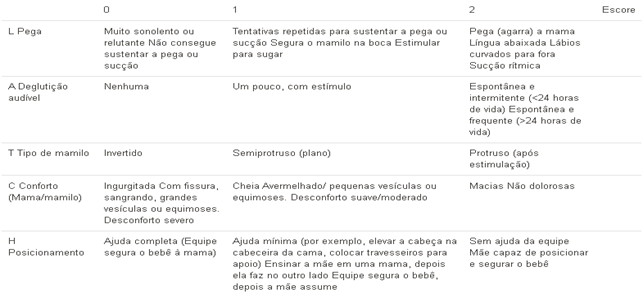
Figure 1 - LATCH scale scoring system.
Source: Griffin et al., 2022.
The LATCH scale classifies BF as good and effective (7-10 points), moderate (4-6 points, requiring adjustments), and poor (0-3 points, requiring correction and support).⁶
Data were organized into tables with absolute and percentage frequencies and analyzed descriptively using proportions, means, and standard deviations. Data tabulation and statistical analysis were performed using Microsoft Excel 2013 and SPSS.
The study complied with Resolutions 466/2012, 510/2016, and 580/2018 of the Brazilian National Health Council, ensuring participant confidentiality, anonymity, and privacy. The project was approved by the Research Ethics Committee at the Federal University of Recôncavo da Bahia (CAAE: 6.546.190).
Results
All 51 postpartum women participating in this study resided in municipalities within the Recôncavo region of Bahia, with a mean age of 27.8 years. Regarding occupation, 29.4% were formally employed, while 25.4% identified themselves as farm workers or agricultural laborers. As for race/skin color, 56.9% self-identified as mixed race, 33.3% as Black, and 9.8% as White. In terms of educational level, the majority—51% of the sample—had completed high school.
Regarding marital status, 56.9% of the postpartum women reported being single, while 21.6% were married. The most common household size, reported by 19.6% of participants, consisted of four people. A family income equivalent to one minimum wage was reported by 33.3% of the women. Notably, a significant number — 10 out of 51 (19.6%) — reported having no family income. The main socioeconomic and obstetric variables of the participants are summarized in Table 1, which details the distribution of sample characteristics.
Table 1 - Socioeconomic and obstetric characteristics of postpartum women. Santo Antônio de Jesus (BA), Brazil, 2024.
|
Maternal characteristics |
Absolute frequency (n) |
Relative frequency (%) |
|
Age |
||
|
<40 years |
49 |
96.1% |
|
>40 years |
2 |
3.9% |
|
Race/skin color |
|
|
|
Mixed race |
29 |
56.9% |
|
Black |
17 |
33.3% |
|
Education level |
|
|
|
Completed high school |
26 |
51% |
|
Incomplete high school |
9 |
17.6% |
|
Completed elementary school |
5 |
9.8% |
|
Completed higher education |
5 |
9.8% |
|
Marital status |
|
|
|
Single |
29 |
56.9% |
|
Married |
11 |
21.6% |
|
Common-law marriage |
11 |
21.6% |
|
Family income |
|
|
|
1 Brazilian minimum monthly wage |
17 |
33.3% |
|
< 1 Brazilian minimum monthly wage |
12 |
23.5% |
|
> 1 Brazilian minimum monthly wage |
10 |
19.6% |
|
Between 3 and 5 Brazilian minimum monthly wages |
1 |
2% |
|
No income |
10 |
19.6% |
|
Occupation |
|
|
|
Formal employment |
15 |
29.4% |
|
Farming/agriculture |
13 |
25.4% |
|
Domestic work |
10 |
19.6% |
|
Self-employment |
5 |
9.8% |
|
Not reported |
8 |
15.7% |
|
Previous pregnancies |
|
|
|
Yes |
28 |
55% |
|
No |
23 |
45% |
|
Previous miscarriages |
|
|
|
Yes |
12 |
42.9% |
|
No |
16 |
57.1% |
|
Previous deliveries |
|
|
|
Cesarean |
16 |
59% |
|
Vaginal |
11 |
41% |
|
Complications in previous pregnancies |
|
|
|
Yes |
11 |
39.3% |
|
No |
17 |
60.7% |
Regarding the pathological history of the postpartum women, 11.8% had comorbidities, with systemic arterial hypertension (SAH) being the most prevalent, diagnosed in 66.7% of these cases, followed by diabetes mellitus (DM), diagnosed in 16.7%. During the interviews, no cases of smoking or illicit drug use were reported; however, 23.5% of participants reported alcohol consumption. The majority of the women—72.5% of the sample—declared having a religious affiliation, while only 15.7% reported engaging in physical activity.
Previous surgeries were reported by 45.1% of the participants, with cesarean section being the most frequently mentioned, accounting for 56.5% of the procedures. Approximately 80.4% of the postpartum women reported a family history of comorbidities, with 78% of these cases occurring among first-degree relatives. Primigravida women made up 45% of the sample. Among those with previous pregnancies that resulted in childbirth, 59% had surgical deliveries and 40.7% had vaginal deliveries. Of the latter, 91% gave birth lying down on a stretcher, and 36.3% underwent episiotomy. At least one previous miscarriage was reported by 42.8% of the participants, and 39.3% reported complications in earlier pregnancies.
Regarding the profile of newborns from previous pregnancies, 15.5% were premature, 11.1% were born preterm, 15% were considered small for gestational age (SGA), and 7.4% large for gestational age (LGA).
Regarding aspects of the current pregnancy, all were reported as resulting from spontaneous fertilization. Of these, 41.2% were planned, 11.8% were unplanned, 64.7% were classified as low-risk, 2% as intermediate-risk, and 33.3% as high-risk. An up-to-date vaccination record was reported by 84.3% of the participants, while 15.7% stated that it had not been updated by the time of delivery.
Complications during the current pregnancy were reported by 60.8% of the postpartum women, with urinary tract infection being the most prevalent, occurring in 35.5% of cases. Cesarean section was the predominant delivery type, accounting for 86.3% of births, while only 13.7% were vaginal deliveries. Complications during childbirth were reported by 5.9% of the participants, including fetal distress (33.3%), hemorrhage (33.3%), and eclampsia (33.3%).
No preterm births were observed in the sample. Among the newborns, 5.8% were small for gestational age, and 13.7% were large for gestational age. Approximately 11.8% did not cry at birth, and 17.6% were not taken out of the delivery room accompanied by their mothers. Of these, 88.9% were separated for less than 1 h.
Most postpartum women (80.4%) reported having received BF counseling (Table 2). It was provided during prenatal care in 60.8% of cases and in the maternity ward in 58.9% of cases. BF counseling was delivered by health care professionals in 78.4% of cases. Skin-to-skin contact was encouraged in 86.3% of cases, and 88.2% of the women began BF within the first hour after birth.
Table 2 - Characteristics related to BF among postpartum women. Santo Antônio de Jesus (BA), Brazil, 2024.
|
Breastfeeding |
Absolute frequency (n) |
Relative frequency (%) |
|
General aspects |
||
|
Prior guidance |
||
|
Yes |
41 |
80.4% |
|
No |
10 |
19.6% |
|
Intention to maintain EBF until 6 months |
|
|
|
Yes |
46 |
56.9% |
|
No |
7 |
33.3% |
|
BF within the 1st hour |
|
|
|
Yes |
45 |
88.2% |
|
No |
6 |
11.8% |
Among the postpartum women, 90.2% expressed interest in maintaining exclusive BF up to 6 months. However, among those who had maternity leave, only 14.3% reported a leave duration of 180 days, equivalent to 6 months.
Regarding the use of the LATCH scale, the overall score was 7, with a minimum of 5 and a maximum of 9. The distribution of absolute and relative frequencies for each postpartum woman’s score on the key components is presented in Table 3.
Table 3 - Características de aleitamento materno das puérperas com base na Escala LATCH. Santo Antônio de Jesus (BA), Brazil, 2024.
|
Assessment of BF quality |
Absolute frequency (n) |
Relative frequency (%) |
|
LATCH Scale/score |
||
|
L – Latch |
||
|
0 |
5 |
9.8% |
|
1 |
38 |
74.5% |
|
2 |
8 |
15.7% |
|
A – Audible swallowing |
|
|
|
0 |
18 |
35.3% |
|
1 |
28 |
55% |
|
2 |
5 |
9.8% |
|
T – Type of nipple |
|
|
|
0 |
0 |
— |
|
1 |
3 |
5.9% |
|
2 |
48 |
94.1% |
|
C – Comfort (breast/nipple) |
|
|
|
0 |
3 |
5.9% |
|
1 |
18 |
35.3% |
|
2 |
3 |
58.8% |
|
H – Hold (positioning) |
|
|
|
0 |
0 |
— |
|
1 |
15 |
29.4% |
|
2 |
36 |
70.6% |
The components latch, audible swallowing, and comfort were the ones that required the most interventions, which explains the final LATCH scores obtained by the postpartum women assessed. The best evaluation results were observed in the positioning of the newborn and the mother during BF as well as in the type of nipple.
Discussion
Most postpartum women in the study self-identified as mixed race or Black, had completed high school, and reported a family income equivalent to one minimum wage. However, a significant percentage reported having incomplete high school education or only elementary-level education, as well as no family income. Family income has been shown to be a determining factor that may hinder exclusive BF. In Brazil, low family income was found to increase the likelihood of early cessation of exclusive BF by 1.22 times.¹
Some researchers consider BF to be one of the few positive health behaviors that is more common among people with lower incomes, particularly because of its cost-saving benefits. Education is also recognized as an important determinant, as in high- and middle-income countries, individuals with higher educational levels tend to breastfeed for longer periods.⁷
BF plays a significant role in achieving the Sustainable Development Goals (SDGs), launched by the United Nations (UN) in 2015 as 17 targets to be met by 2030.⁸ Both directly and indirectly, BF is linked to all the SDGs and is essential for achieving goals such as poverty eradication, zero hunger and improved nutrition, and maternal and child health and well-being.⁷
In the Brazilian context, the National Policy for Comprehensive Child Health Care (Política Nacional de Atenção Integral à Saúde da Criança [PNAISC]), specifically in its second axis, which addresses BF and healthy complementary feeding, is grounded in the promotion, protection, and support of BF. It recognizes the benefits of BF for the child, the mother, and society as well as the importance of establishing healthy eating habits.⁹
A literature review study showed that changes in hospital practices, based on the Ten Steps to Successful BF (Baby-Friendly Hospital Initiative [BFHI]), increased the prevalence of BF.¹⁰ A study conducted in the Southwest region of Bahia reported a mean maternal age of 27.7 years (standard deviation [SD] = 6.5), which is close to the average observed in the present study.¹¹ Maternal age is a factor to consider in BF adherence and duration, as some authors have noted that increasing age is associated with higher likelihood of BF self-efficacy.¹²
Another study showed that 63% of the mother–infant dyads initiated BF within the first hour after birth.¹³ In contrast, a higher percentage—88.2%—of the postpartum women in the present study breastfed within the first hour. This result may be attributed to the BFHI, granted by the Brazilian Ministry of Health, which is implemented at the maternity hospital where the participants were admitted.
Some of the goals of the BFHI include reducing infant morbidity and mortality by promoting BF; mobilizing and training health care professionals to change inappropriate routines and practices that may hinder BF and lead to early weaning; and implementing the Ten Steps to Successful BF, established by United Nations Children’s Fund (UNICEF) and the World Health Organization (WHO).¹⁴
The results related to BF within the first hour of life are higher than those observed in Brazil in 2020, when the prevalence of continued BF within the first hour reached 53.1%. Moreover, the percentage observed among the mother–infant dyads in this study already meets the global target for 2030, which is approximately 70%.¹⁵
Lower scores were observed in the key components of the LATCH scale related to poor latch (9.8%) and inaudible swallowing (35.3%), which guided the interventions for these mother–infant dyads. The focus was on correcting technique and providing guidance on signs of improper latch and ineffective sucking. These findings are similar to those of another study, in which 36.9% (60/162) of newborns had lower scores for latch quality and 49.4% (80/162) showed inaudible swallowing during the assessment.¹³
For an effective assessment of BF, the use of validated instruments is essential. The LATCH scale is the most commonly used tool in clinical practice, as it identifies factors that affect BF technique and helps guide the appropriate interventions to improve the mother–infant dyad’s experience.¹
The use of the LATCH scale by nursing staff reinforces the importance of considering various aspects of the BF process, such as the quality of the newborn’s latch, swallowing during feeding, type of nipple, maternal comfort, and the need for assistance with infant positioning. Changes in these key components may lead to later complications that can hinder the BF process.¹
Continuous support for mothers, education during prenatal care, and awareness of the importance of maintaining BF were identified as key elements for promoting successful BF and contributing to the well-being of both mother and newborn. This highlights the critical role of nursing care throughout pregnancy, childbirth, and the postpartum period.
The experience gained by the researcher involved in the study was essential for developing focused clinical reasoning tailored to the immediate needs of the mother–infant dyads. Applying the LATCH scale at the bedside and using the “light technology” of individualized guidance—capable of reducing anxiety and addressing the postpartum women’s questions and challenges regarding the BF process—is a nursing care strategy that can help prevent prolonged hospital stays.¹⁶
The present study had some limitations that should be noted. It was conducted in a single public maternity hospital over a short period, which may limit the generalization of the findings to other regions or rooming-in care settings in Bahia. This limitation can be addressed through further scientific research stemming from multicenter studies. Additionally, the study focused on quantitative assessments, leaving room for future qualitative investigations that explore mothers’ subjective experiences during BF.
Regarding the study’s contributions to the nursing staff in the field of maternal and child health, the use of the LATCH scale — developed by American nurses and validated in Portuguese — allows for accurate and early assessment, helping identify major BF difficulties and enabling immediate and effective interventions. In this context, conducting qualitative studies can contribute to a deeper understanding of the specific aspects of the BF process.
Conclusion
In the setting studied, BF practices were assessed using the LATCH scale and were found to be effective; however, certain items may require adjustment. While the LATCH tool offers a general classification of BF, it is essential to adopt an individualized approach to each assessed component. Targeted adaptations and support are crucial to guide appropriate care and prevent issues that may compromise the quality of BF practices.
The care provided by the researcher in the rooming-in unit, using the LATCH scale, proved to be highly valuable for clinical decision-making. The study reinforces the essential role of nursing in the promotion, protection, and support of BF, highlighting how the use of systematic tools can significantly improve the quality of care offered to postpartum women and their newborns.
Authors Contributions
Study design: Ivana Karolina Sousa Santos e Michelle de Santana Xavier Ramos. Data collection: Ivana Karolina Sousa Santos. Data analysis and interpretation: Ivana Karolina Sousa Santos e Michelle de Santana Xavier Ramos. Writing of the manuscript: Ivana Karolina Sousa Santos e Michelle de Santana Xavier Ramos. Critical revision of the manuscript: Deisy Vital de Melo, Lucas Amaral Martins, Camilla da Cruz Martins. Approval of the final version of the text: Michelle de Santana Xavier Ramos e Camilla da Cruz Martins.
Conflict of interest
The authors have declared that there are no conflicts of interest.
References
- Silva ALB, Ferreira CRS, Santos PG, Oliveira ERA, Miotto MHMB. Determinantes em saúde associados ao aleitamento materno exclusivo: uma revisão de escopo. Revista CEFAC. V. 25, n.5: e6822, 19p, 2023. DOI: https://doi.org/10.1590/1982-0216/20232556822s
- Organização Mundial da Saúde (OMS). Recomendações da OMS sobre cuidados maternos e neonatais para uma experiência pós-natal positiva. Genebra: Organização Mundial da Saúde; 2022. ISBN 978-92-4-004851-5.
- Emidio SCD, Oliveira VRRF, Carmona EV. Mapeamento das intervenções de enfermagem no estabelecimento da amamentação em uma unidade de internação neonatal. Revista Eletrônica de Enfermagem. V. 22. 2020. DOI: https://doi.org/10.5216/ree.v22.61840
- Griffin CM, Amorim MH, Almeida FA, Marcacine KO, Goldman, RE, Coca KP. LATCH como ferramenta sistematizada para avaliação da técnica de amamentação na maternidade. Acta Paulista de Enfermagem. V.35, 2022. DOI: https://doi.org/10.37689/acta-ape/2022AO03181
- Conceição CM, Coca KP, Alves MR, Almeida FA. Validação para língua portuguesa do instrumento de avaliação do aleitamento materno LATCH. Acta Paulista de Enfermagem. V. 30, n. 2, p.210-216, 2017. Available from: https://www.scielo.br/j/ape/a/Nq96QRH8gwWmKvyTRPLn4KQ/?format=pdf&lang=pt
- Sowjanya SV, Venugopalan L. LATCH score as a predictor of exclusive breastfeeding at 6 weeks postpartum: a prospective cohort study. Breastfeeding Medicine. V. 13, n. 6, p.444-449, 2018. DOI: https://doi.org/10.1089/bfm.2017.014
- Monteiro JCS, Silva MMJ, Lima RVA, Ruela LO, Gomes-Sponholz FA, Lettiere-Viana A. Determinantes sociais da saúde, aleitamento materno e diminuição das iniquidades em saúde. Research, Society and Development, v. 11, n. 2, e7411225558, 2022. DOI: http://dx.doi.org/10.33448/rsd-v11i2.25558
- Organização das Nações Unidas (ONU). Objetivos de Desenvolvimento Sustentável no Brasil. Nações Unidas Brasil, 2024 [cited 2024 jun 07]. Available from: https://brasil.un.org/pt-br/sdgs
- Brasil. Ministério da Saúde. Secretaria de Atenção à Saúde. Departamento de Ações Programáticas Estratégicas. Política Nacional de Atenção Integral à Saúde da Criança : orientações para implementação. Ministério da Saúde. Brasília : Ministério da Saúde, 2018. 180 p. : il. ISBN 978-85-334-2596-5.
- Figueredo SF, Mattar MJG, Abrão ACF de V. Iniciativa Hospital Amigo da Criança: uma política de promoção, proteção e apoio ao aleitamento materno. Acta Paul Enferm [Internet]. 2012; 25(3):459–63. DOI: https://doi.org/10.1590/S0103-21002012000300022
- Sousa PKS, Novaes TG, Magalhães EI da S, Gomes AT, Bezerra VM, Pereira Netto M, et al.. Prevalência e fatores associados ao aleitamento materno na primeira hora de vida em nascidos vivos a termo no sudoeste da Bahia, 2017. Epidemiol Serv Saúde [Internet]. V. 29, n. 2, e2018384, 2020. DOI: https://doi.org/10.5123/S1679-49742020000200016
- Siqueira LS, Santos FS, Santos RM de MS, Santos LFS, Santos LH dos, Pascoal LM, et al. Fatores associados à autoeficácia da amamentação no puerpério imediato em maternidade pública. Cogitare Enferm [Internet]. V. 28, e84086, 2023. DOI: https://doi.org/10.1590/ce.v28i0.84086
- Gomes DS de A, Silva L da, Silvestrim PR, Oliveira TM de, Pimenta RA. Escores de aleitamento materno no alojamento conjunto: aplicação da Escala LATCH. Ciênc. cuid. saúde [Internet]. 2023;220. Available from: https://periodicos.uem.br/ojs/index.php/CiencCuidSaude/article/view/65565
- Brasil. Iniciativa Hospital Amigo da Criança. Ministério da Saúde, 2024 [cited 2024 jun 6]. Available from: https://www.gov.br/saude/pt-br/assuntos/saude-de-a-a-z/a/aleitamento-materno/ihac
- Universidade Federal do Rio de Janeiro. Estudo Nacional de Alimentação e Nutrição Infantil - ENANI-2019: resultados preliminares - Indicadores de aleitamento materno no Brasil. [Internet] Rio de Janeiro: UFRJ, 2020.
- Merhy EE. Saúde: a cartografia do trabalho vivo. 2. ed. São Paulo: Hucitec , 2005. DOI: https://doi.org/10.1590/S0102-311X2008000800023
Corresponding Author
Ivana Karolina Souza Santos
E-mail: ivanakarolinaenfa@gmail.com
© The Author(s) 2025. This work is licensed under Creative Commons Attribution 4.0 International. License text for use: https://creativecommons.org/licenses/by/4.0/
 Português (Brasil)
  English
  Español (España)