
Classificação de trilhas ecológicas com base em critérios físicos e ambientais: estudo de caso em Cachoeira Bahia
DOI:
https://doi.org/10.51359/2238-6211.2025.267160Palavras-chave:
trilhas ecológicas, geodiversidade, Recôncavo da Bahia, planejamento ambientalResumo
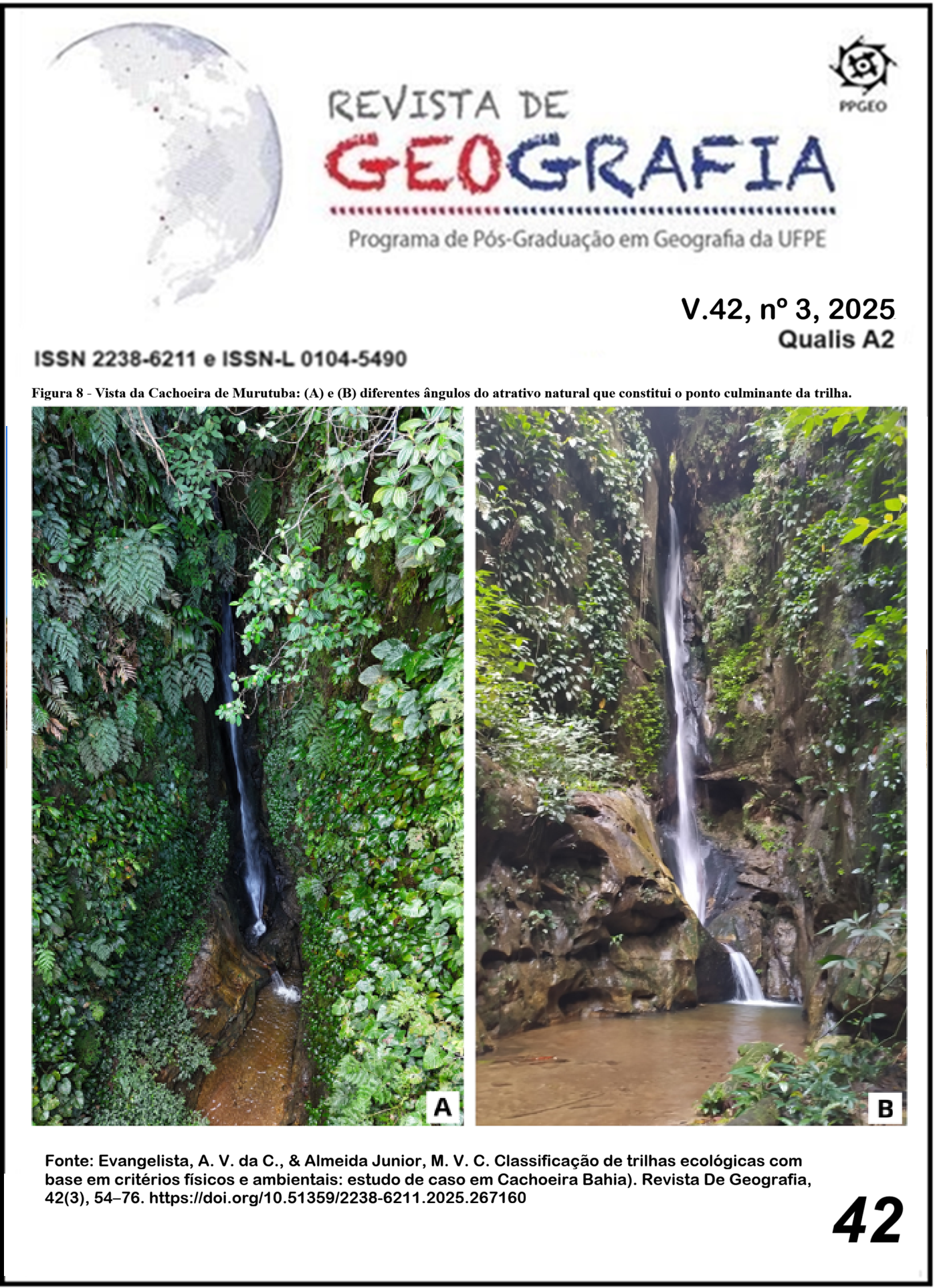
O município de Cachoeira (BA), reconhecido por sua relevância histórica e ambiental, apresenta elevado potencial para o ecoturismo em trilhas. Este estudo analisou duas rotas locais — Cachoeira de Murutuba e Cachoeira da Escada do Sino — com o objetivo de identificar, caracterizar e classificar seus graus de dificuldade, subsidiando o planejamento de atividades ecoturísticas sustentáveis. A pesquisa utilizou dados bibliográficos, geoprocessamento e levantamentos de campo, considerando aspectos geológicos, pedológicos, geomorfológicos e de cobertura vegetal. As trilhas foram segmentadas e classificadas em trechos fáceis, moderados e difíceis, de acordo com critérios como esforço físico, riscos naturais, orientação e declividade. A trilha da Cachoeira de Murutuba apresentou predominância de trechos fáceis e moderados, com trechos difíceis localizados próximos à queda d’água. Já a trilha da Cachoeira da Escada do Sino, apesar de mais extensa, foi classificada apenas como fácil e moderada, sem ocorrência de trechos difíceis, sendo adequada a um público mais amplo. Os resultados evidenciam interferências antrópicas, como uso agropecuário e presença de vegetação secundária, além de aspectos geológicos variados. O estudo destaca a necessidade de manejo e sinalização adequados para garantir a segurança dos visitantes e a conservação dos recursos naturais, reforçando o papel das trilhas como instrumento de educação ambiental e promoção do ecoturismo sustentável na região.
Referências
AMIDEN NETO, G. Potencial ecoturístico do Recôncavo Sul Baiano. Monografia (Especialização em Ecoturismo) – Universidade de Brasília, Centro de Excelência em Turismo, Brasília, 2004. 71 f. DOI: http://dx.doi.org/10.26512/2004.TCC.382
ANDRADE, W. J.; ROCHA, R. F. Manejo de trilhas: um manual para gestores. Instituto Florestal, Série Registros, n. 35. São Paulo, 2008. 74p.
BDIA - Banco de Dados e Informações Ambientais. Mapeamento de Recursos Naturais (MRN): escala 1:250 000. Instituto Brasileiro de Geografia e Estatística, Coordenação de Meio Ambiente. Rio de Janeiro: IBGE, 2023. 64 p.: il., mapas.
CAMPOS, R. F.; FILLETO, F. Análise do perfil, da percepção ambiental e da qualidade da experiência dos visitantes da Serra do Cipó (MG). Revista Brasileira de Ecoturismo, 4: 69-94. 2011. DOI: https://doi.org/10.34024/rbecotur.2011.v4.5902
CARVALHO, J.; BÓÇON, R. Planejamento do traçado de uma trilha interpretativa através da caracterização florística. Revista Floresta, 34: 23-32. 2004. DOI: https://doi.org/10.5380/rf.v34i1.2372
COSTA, V. C. Proposta de manejo e planejamento ambiental de trilhas ecoturísticas: um estudo no Maciço da Pedra Branca - município do Rio de Janeiro (RJ). Anuário do Instituto de Geociências, Rio de Janeiro, 29(2): 226-227. 2006. DOI: https://doi.org/10.11137/2006_2_226-227
FEMERJ – Federação de Montanhismo do Estado do Rio de Janeiro. Metodologia de Classificação de Trilhas v6.1. 53 p. 2016. Disponível em: http://femerj.org/images/arquivos/classificacao-trilhas-v5.0.pdf.
IBGE. Instituto Brasileiro de Geografia e Estatística. Áreas territoriais dos municípios: malha municipal digital. 2022. Disponível em: https://www.ibge.gov.br/geociencias/organizacao-do-territorio/estrutura-territorial/15761-areas-dos-municipios.html.
IBGE. Instituto Brasileiro de Geografia e Estatística. Cachoeira (BA) – Panorama Cidades@. 2022. Disponível em: https://cidades.ibge.gov.br/brasil/ba/cachoeira/panorama.
MITRAUD, S. (Org.). Manual de ecoturismo de base comunitária: ferramentas para um planejamento sustentável. Brasília: WWF Brasil, 2003. 470 p.
OLIVEIRA, E. P.; MCNAUGHTON, N. J.; ARMSTRONG, R. Mesoarchaean to Palaeoproterozoic growth of the northern segment of the Itabuna-Salvador-Curaca orogen, Sao Francisco Cráton, Brazil. In: Kusky, T. M.; Zhai, M. G.; Xiao, W. (orgs.). The evolving continents: understanding processes of continental growth. London: Geological Society, p. 263-286. 2010.
PRODANOV, C. C.; FREITAS, E. C. Metodologia do trabalho científico: métodos e técnicas da pesquisa e do trabalho acadêmico-2ª Edição. Editora Feevale, 2013.
ROSARIO, E. C. Cachoeira: uma cidade heroica. Cachoeira, 2005,10p. : il.
SENICIATO, T.; CAVASSAN, O. Aulas de campo em ambientes naturais e aprendizagem em ciências: um estudo com alunos do ensino fundamental. Ciência e Educação (Bauru), v. 10, n. 1, p. 133-147, 2004.
TATUMI, S. H.; SILVA, L. P.; PIRES, E. L.; ROSSETTI, D. F.; GÓES, A. M.; MUNITA, C. S. Datação de sedimentos Pós-Barreiras no norte do Brasil: implicações paleogeográficas. Revista Brasileira de Geociências, São Paulo, v. 38, n. 3, p. 514–524, set. 2008.
VASCONCELLOS, J. M. O. Avaliação da eficiência de diferentes tipos de trilhas interpretativas no Parque Estadual Pico do Marumbi e Reserva Natural Salto Morato – PR. Natureza e Conservação, Curitiba, v. 2, n. 2, p. 48-57, 2004.
Downloads
Publicado
Como Citar
Edição
Seção
Licença
Copyright (c) 2025 Ana Vitória da Costa Evangelista, Marcus Vinicius Costa Almeida Junior

Este trabalho está licenciado sob uma licença Creative Commons Attribution 4.0 International License.
Autores que publicam nesta revista concordam com os seguintes termos:
a) Autores mantêm os direitos autorais e concedem à REVISTA DE GEOGRAFIA da Universidade Federal de Pernambuco o direito de primeira publicação, com o trabalho simultaneamente licenciado sob a Licença Creative Commons Atribuição 4.0 Internacional. CC BY -  . Esta licença permite que os reutilizadores distribuam, remixem, adaptem e criem a partir do material em qualquer meio ou formato, desde que a atribuição seja dada ao criador. A licença permite o uso comercial.
b) Autores têm autorização para assumir contratos adicionais separadamente, para distribuição não-exclusiva da versão do trabalho publicada nesta revista (ex.: publicar em repositório institucional ou como capítulo de livro), com reconhecimento de autoria e publicação inicial nesta revista.
c) Autores têm permissão e são estimulados a publicar e distribuir seu trabalho online (ex.: em repositórios institucionais ou na sua página pessoal) a qualquer ponto antes ou durante o processo editorial, já que isso pode gerar alterações produtivas, bem como aumentar o impacto e a citação do trabalho publicado.
d) Os conteúdos da REVISTA DE GEOGRAFIA estão licenciados com uma Licença Creative Commons Atribuição 4.0 Internacional. CC BY - . Esta licença permite que os reutilizadores distribuam, remixem, adaptem e criem a partir do material em qualquer meio ou formato, desde que a atribuição seja dada ao criador. A licença permite o uso comercial.
No caso de material com direitos autorais a ser reproduzido no manuscrito, a atribuição integral deve ser informada no texto; um documento comprobatório de autorização deve ser enviado para a Comissão Editorial como documento suplementar. É da responsabilidade dos autores, não da REVISTA DE GEOGRAFIA ou dos editores ou revisores, informar, no artigo, a autoria de textos, dados, figuras, imagens e/ou mapas publicados anteriormente em outro lugar.
