Memory, market, and ritual
An essay on All Souls' Day at the Senhor da Boa Sentença cemetery / PB
DOI:
https://doi.org/10.51359/2526-3781.2025.265711Keywords:
antropologia da morte, Ritual, Memória, dia de finados cemitérioAbstract
This ethnographic essay (MALINOVSKI, 1978) aims to analyze the social, economic and symbolic dynamics observed during All Souls' Day in the year 2024. The research seeks to understand the interactions between visitors, traders and workers, as well as the cemetery organization and funeral rituals practiced in the cemetery (REIS, 1991).
The arrival at the field occurred shortly before five o'clock, and the images captured had the natural lighting of dawn being considered for the composition of the images. The spatial arrangement of the traders revealed a structured organization according to the different accesses to the site. Photography of the site became an essential tool in the ethnographic work, it was essential to record and collaborated in the analysis of the data, according to the thinking of Landa et al (2014).
The research identified the economic and social relevance of commerce during the event, characterized both by the sale of symbolic items and by the interaction between vendors and visitors. Exploratory interviews were conducted with merchants, who highlighted the importance of the date for generating income. The presence of essential service workers, such as street vendors and cleaning crews, whose work structured the functioning of the space, was also observed.
The gradual increase in the flow of visitors was recorded after six o'clock, coinciding with the beginning of religious celebrations. Different forms of tribute to the dead were identified, ranging from large floral arrangements to the lighting of individual candles. A dialogue about the abolition of burial in churches stood out, highlighting discussions about social distinctions in funeral spaces (ARIÉS, 1981).
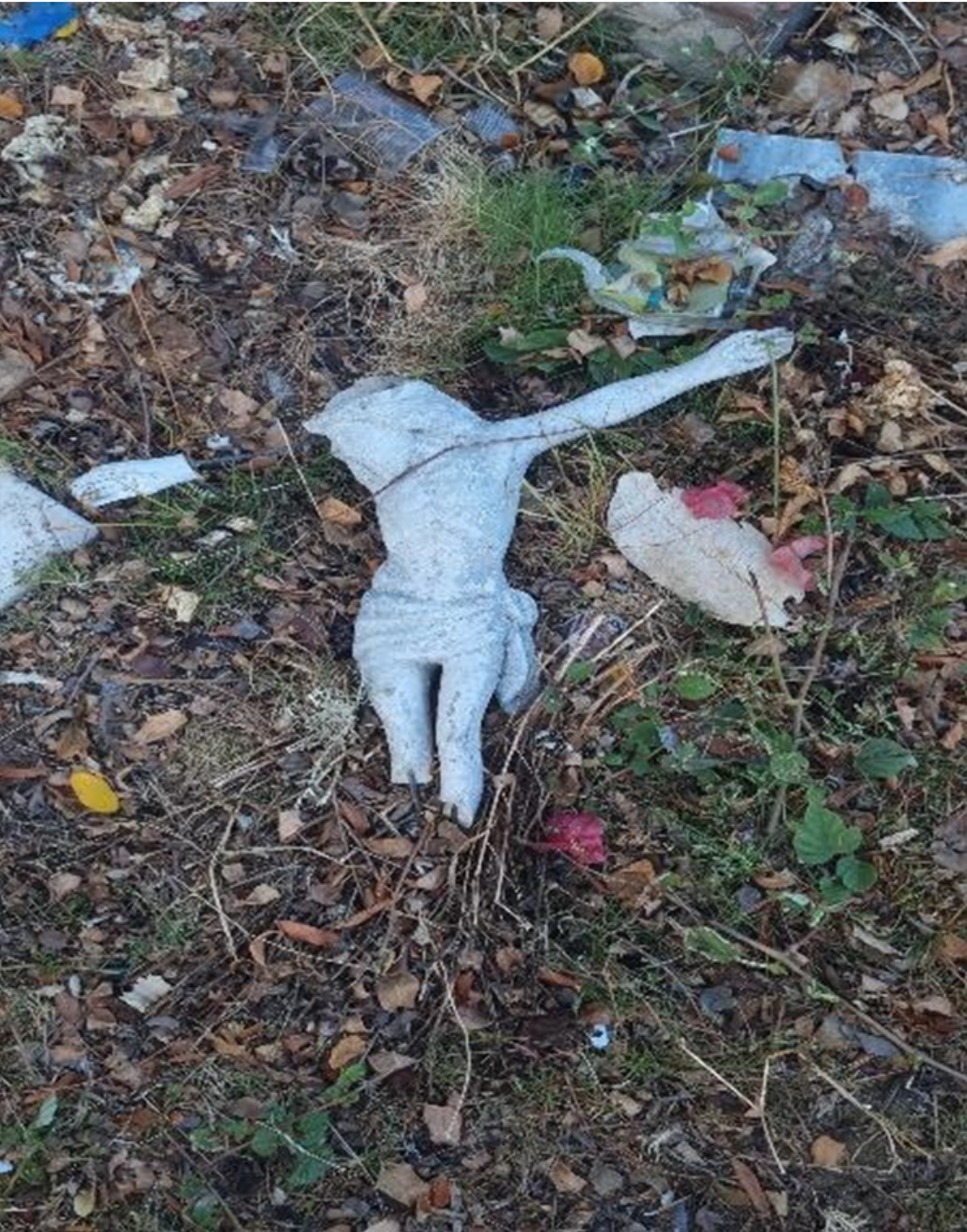
Three specific aspects were analyzed: the lack of adequate signage, compromising the orientation of visitors; the central cross of the cemetery as a point of convergence of diverse religious practices; and the increase in the number of candles, interpreted as symbols of memory and spiritual connection. A relevant observation was the state of deterioration of a statue of Jesus, abandoned among the tombs, evidencing a possible neglect of the maintenance of the funeral space. The verbalized reaction of a visitor – "Where's the administration? Jesus is on the floor..." – reinforced the symbolic charge of the scene, and a dimension of dirt (DOUGLAS, 1976)
The photographic documentation and observations made it possible to understand the intersection between ritual practices, the economy of death, and the sociocultural dynamics of All Souls' Day. The collected records contribute to the analysis of the relationship between memory, market, and religion in the urban funeral context. In this way, the perception of the social dynamics that involve the cemetery with its sociocultural practices is associated with the historical context experienced, and the relationships built between individuals helped to understand the cemetery space not only as a place of death, but mainly as a space of life, social activity, memory, and symbolic continuity, where the mourners resist strengthening their cultural practices even with all the forms of the scenario of loneliness of experiencing this day (SILVA, 2021).
References
ARIÈS, Philippe. O homem diante da morte. Rio de Janeiro: Francisco Alves, 1981.
DOUGLAS, Mary. Pureza e perigo. São Paulo: Ed. Perspectiva, 1976.
LANDA, Mariano Báez. Ferraz, Ana Lúcia Camargo; Mendonça, João Martinho de Ana Lúcia Camargo Ferraz e João Martinho de Mendonça (Orgs.). Antropologia visual: perspectivas de ensino e pesquisa; Brasília- DF: ABA, 2014.
MALINOVSKI, B. 1978. “Introdução” In Malinowski, Os argonautas do Pacífico Ocidental, Col. Os Pensadores. S.P: Abril editores.
REIS, João José. A morte é uma festa: ritos fúnebres e revolta popular no Brasil do século XIX. São Paulo: Companhia das Letras, 1991.
SILVA, Weverson Bezerra. Dia dos mortos na pandemia: as fases de vivenciar a morte no cemitério em tempos de solidão. Revista de @ntropologia da UFSCar, 13 (2), jul./dez. 2021.
Published
Issue
Section
License
Copyright (c) 2025 AntHropológicas Visual

This work is licensed under a Creative Commons Attribution-NonCommercial 4.0 International License.
Direitos Autorais para trabalhos audiovisuais publicados na AntHropológicas Visual sã licenciados para uma licenca Creative Commons 4.0 BY-NC.
