Seeking for Sleep
Keywords:
Baniwa, Kuripako, ethnofiction, Visual-Anthropology, Indigenous-Cinema, Ethnographic-filmAbstract
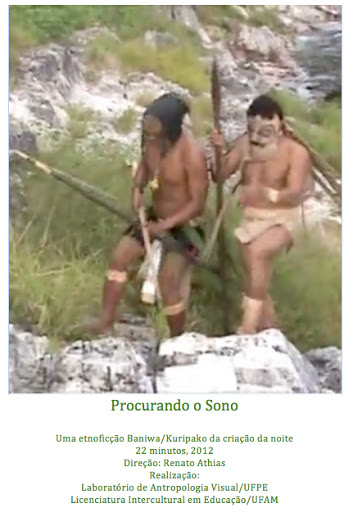
This ethnofiction presents the myth Kuripaco/Baniwa of the night’s arrival trough the Baniwa/Kuripako’s acting during the Intercultural’s Licentiate Course of UFAM. The movie’s script was discussed and organized among the students who created the clothes design dressed by the characters for the acting made in February of 2011 at the stones of Içana’s river, close to Tunuí.
The film “Procurando o Sono” is the representation of Baniwa and Kuripako understands about the night’s arrival at the current world. Those stories have many versions. And each one of the tribes has their own version and interpretation. There’s no “canonical” form of this myth that is common knowledge and exceeds generations. Each group seeks to disseminate, tell, and narrate with elements that fortify the tribe of those who are telling the story. To produce the film, the Kuripako and Baniwa students, who participate of the production of this film, spent many hours assembled searching this common version that would be performed and then filmed. In this version it is mostly noticed the common elements of the different narrative. And about this process of the versions negotiation it is realized the many identities of the Kuripako and Baniwa. The performance dimension has a remarkable resonance because it is believed that image in movement is an instrument more approachable to oral narration and handle a debate that trigger many reactions on the people who are watching it. The dramatic narrative of the film’s theme allow to put the watchers, the audience, in a position of understanding what the narrative is providing, in this case is a mythological story about day splitting the night. After watching many times the film, it is realized that the image narrative, constructed by the Baniwa and Kuripako, allows record mostly re-stablish a temporal space where the manifestation happens trough gesture, words, scenery, creating a dialogue with Clifford Geertz’s “understanding of the cultural understanding”. This understanding aspect is seen on the images trough the film. The description, the image of what is filmed, acquires an interlocution and highlights symbolic aspects on the film. The important thing, Geertz would say, “Is to discover together with them what the hell they are doing” (1997:89).
Credits:
Direction: Renato Athias
Montage: Charles Martins
Subtitles: Mônica Apolinário
Mini-dv captured images
Production: Visual Anthropology Laboratory (UFPE)
33:06 minutes
Downloads
Published
Issue
Section
License

This work is licensed under a Creative Commons Attribution-NonCommercial 4.0 International License.
Direitos Autorais para trabalhos audiovisuais publicados na AntHropológicas Visual sã licenciados para uma licenca Creative Commons 4.0 BY-NC.
